

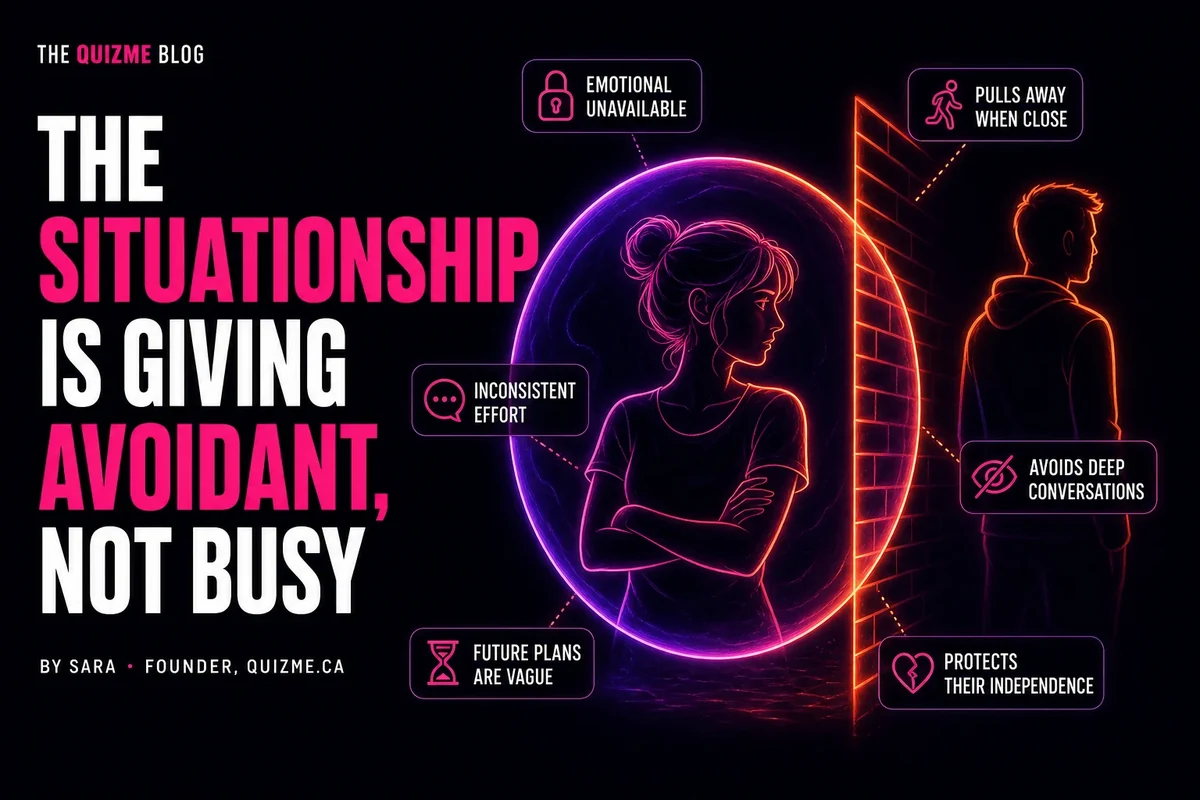
Is It Avoidant Attachment or Are They Just Busy?
“Work has been insane lately.” You’ve read that text, and you’ve also watched the same person post a story from a rooftop at 11 p.m. Busy people reschedule. Avoidant people recalibrate. If someone is warm in person, vague about the future, and strangely unreachable whenever things start to feel real, the pattern points to avoidant attachment more often than to a full calendar. Researchers define attachment avoidance as discomfort with emotional closeness and reliance on others. A situationship, with all the intimacy and none of the accountability, is nearly the perfect habitat for it. That’s the bottom line, and it isn’t a diagnosis.
Your generation already has the vocabulary. Breadcrumbing, ghosting, orbiting, “we’re just vibing,” and “I’m not looking for anything serious right now” (said after eight weeks of weekend sleepovers). Nobody needed a textbook to name these. What the slang can’t do is explain why someone would keep showing up for the good parts and vanish for everything else. Attachment research can, which is why this piece starts with your group chat instead of with Bowlby.
A note on where this comes from. It draws on the original adult attachment models from Hazan and Shaver and from Bartholomew and Horowitz, plus review literature on how avoidant people handle closeness. “Situationship” is slang, and I found no study that measured situationships directly. Connecting the two is informed inference, not settled science. Treat it as a lens, not a verdict.
If you’ve typed “why won’t he commit” (or she, or they) into a search bar at 1 a.m., the honest answer is rarely one thing. This article is for the cases where the answer is a pattern and not a scheduling problem.
Why Avoidant Attachment Fits the Situationship So Well (and Where It Stops)
Cindy Hazan and Phillip Shaver made the move that made all of this possible in 1987. They argued that adult romantic love works like the bond between an infant and a caregiver, with the same needs for closeness, comfort, and a safe base.1 Bartholomew and Horowitz then sharpened the picture in 1991 by asking two questions about a person’s inner working model: what do you believe about yourself, and what do you believe about other people?2 Positive views of both gives you secure attachment. A positive view of yourself and a negative view of others gives you the dismissive-avoidant pattern. Negative about both gives you fearful-avoidant. Negative about yourself and positive about others gives you anxious-preoccupied.
Modern researchers often boil this down to two dials: attachment anxiety, which is the fear of rejection and abandonment, and attachment avoidance, which is discomfort with closeness and dependence. They’re separate dials, not opposite ends of one. That matters for situationships, because the person who seems “chill” about no label and the person who is quietly dying over the no-label are not on the same dial at all.
Now the mechanism. Mikulincer and Shaver, whose work is summarized in most attachment overviews, describe how dismissive individuals handle distress: closeness seems unlikely to help, so they deliberately deactivate the attachment system, hold back from seeking support, and commit to handling things alone. They learn to suppress emotion at the behavioral level, though they still feel it internally. So the person who goes silent after an intense weekend is not necessarily calm. They may be flooded and managing it by leaving the room.
Hazan and Shaver’s early findings on avoidant lovers fit the situationship eerily well: fear of intimacy, emotional ups and downs, uncertainty about their own feelings, and a belief that romantic love rarely lasts and is hard to fall into.1 Clinical psychologist Julie Smith describes the felt version. When a partner seeks intimacy, the barriers go up, and the more they try to get close, the more the avoidant person pulls back.
A situationship removes the two things that switch deactivation on: expectations and obligation. No label means no “what are we,” no meeting the parents, no shared calendar. It lets someone stay close enough to enjoy you and far enough to feel safe.
Translated into situationship terms (and this is interpretation, not a measured finding), the four styles tend to look different. A secure person says what they want, even when the answer is “not this.” An anxious-preoccupied person over-reads silence, texts first, and stays hoping it becomes official. A dismissive-avoidant person is great in person, vague about plans, and withdraws after closeness. A fearful-avoidant person wants closeness and fears it, so the signals run hot and cold.
Where it stops: not everyone in a situationship is avoidant. Anxious people stay in ambiguity too, because ambiguity feeds hope, and sometimes both people chose the vagueness because they’re twenty-four, in the middle of a move, and unsure. Attachment style is also a tendency, not a script. Plenty of avoidant-leaning people commit happily once the conditions feel safe, which is the next section’s problem.
Can an Avoidant Person Actually Commit? Busy, Avoidant, and Everything Between
Yes. Attachment styles are patterns of expectation, not sentences. Most people stay in the same style over long stretches, but a meaningful minority shift, especially after corrective relationships or therapy. Avoidant people do commit, often after the relationship has felt safe enough for long enough. What tends not to work is pressure, because pressure is exactly what the deactivation strategy is built to escape.
There’s a second reason the answer isn’t “once avoidant, always avoidant.” Research by Caron and colleagues suggests people hold attachment models at several levels at once, a bit like Russian dolls: a global model, models for specific domains such as family, friends, and romantic partners, and models for one particular person.3 You can feel secure with your best friend and deeply insecure with a partner. It follows that someone can be reliable with their friends and slippery with you, and that part of the slipperiness may come from the structure you’ve built together, not just from their childhood.
So how do you tell “busy” from “avoidant”? Genuinely busy people usually stay warm and consistent, name the constraint, and offer a specific alternative (“crushed this week, Sunday dinner?”). Avoidant distance tends to track closeness instead of the calendar: it shows up after a vulnerable conversation, after you’ve said something that sounded like a future, or after a stretch that felt especially good. Busy is tied to the schedule. Avoidance is tied to intimacy. Neither is a rule, and a person can be both.
Then there’s the fearful-avoidant version, which gets mistaken for the dismissive one all the time. Schachner, Shaver, and Mikulincer describe fearful-avoidant adults as coping like dismissive ones by distancing themselves, but unlike them they keep feeling anxiety and neediness about the partner’s love and reliability. Simply Psychology’s review notes such people may stay in the casual dating stage for a long time, not because they want to, but because closeness is frightening. That is the person who sends a paragraph of tenderness at midnight and a “lol been slammed” on Tuesday. They aren’t playing you. They may be as confused as you are.
One more possibility deserves an honest mention: sometimes they just aren’t that into you, and attachment theory is a softer way to say it. The pattern is useful information, but a pattern isn’t a promise that you’re the exception who could unlock them.
Feeling called out? Read The Attachment Style You Didn’t Know You Had and find your own pattern. It takes about 3 minutes.
Three Experiments to Run Before You Decide
Track the Pattern, Not the Text
For three weeks, keep a rough note of when the distance happens. Not what the message said, but what came right before it. Was it after a deep talk? After you mentioned a wedding in June? After a night that felt close? If the gaps line up with their workload (big launches, travel, exams), busy is a fair explanation. If they line up with moments of closeness, that’s the signature of deactivation. You aren’t building a case. You’re replacing a feeling with a data point, which is considerably kinder to your nervous system than refreshing their last-active status.
Make One Small, Clear Ask
Pick something specific and low drama: Thursday dinner, or meeting one friend. No ultimatum, no “where is this going.” Then watch the response, not the wording. A secure person tends to give a clear yes or a clear no. An avoidant person often gives something warm and vague: “definitely, let’s figure it out,” followed by silence. Both answers are information, and the vague one tells you something about how much weight this can carry, at least for now. Asking also gives you something that months of decoding never will: a response to a real request.
Audit Your Own Reading
Before you decode them, answer a question about yourself: what do I do when ambiguity hits? Some people chase, some go quiet and pretend not to care, and some overexplain and then regret it. If you tend to read a six-hour reply gap as abandonment, your own dial may be colouring the data. If you keep choosing people who can’t be pinned down, it may be worth reading why you chase and they pull away and why you keep dating the same person. Neither is a judgment. They’re a mirror.
The Common Pitfall: Diagnosing Them Instead of Reading Yourself
“Avoidant” is the new “toxic,” and it’s being used the same way: as a fast verdict that ends the conversation. Once you’ve decided they’re avoidant, everything they do becomes evidence, the flaky Tuesday and the sweet Sunday alike. Labels also conveniently skip the harder question. Not “what’s wrong with them?” but “why am I still here, and what am I hoping will change?” A person can have a real avoidant pattern and still be the wrong place for you to keep waiting.
The related trap is the loop itself. Avoidant and anxious patterns feed each other: the reaching makes the withdrawing feel necessary, and the withdrawing makes the reaching feel urgent. If you’ve ever felt that spiral, why you trauma bond with the wrong people goes deeper on why the intensity can feel like chemistry. And if the destination of your group chat is always “it’s his Gemini moon,” the same caution applies to star-chart explanations. Your sign didn’t break you up says it well: charts can be a fun language for a pattern, but they shouldn’t be doing the work of explaining one.
Finally, remember what the tools measure. Personality frameworks like the MBTI and the Big Five describe how you generally operate. Attachment describes what happens when closeness is on the line, and it’s most often measured by self-report, which means it reflects how someone sees themselves, not a fixed fact about their heart. Quizzes are a starting point for questions. They aren’t a ruling on anyone.
What Self-Knowledge Is Actually For (and Where to Start)
The point of knowing your attachment pattern isn’t to sort people into safe and unsafe. It’s to stop negotiating with ambiguity as if it were a personality trait you were supposed to tolerate. Once you can see the shape of the thing, you get to choose: stay with open eyes, ask for something clearer, or leave without waiting for a closure conversation that was never coming.
Self-knowledge won’t make someone commit. It makes you stop confusing availability with potential.
If you’re starting from scratch, begin with yourself. The Attachment Style You Didn’t Know You Had is a good first stop, and the relationship section collects the quizzes and pieces that sit around it. If the situationship began on an app, why swiping wrecks your nervous system explains the context you’re dating in. And if you want the bigger map of how traits, types, and patterns fit together, the personality quizzes are a good place to wander. Ambiguity tolerance, like most things, is learned more easily once you know what you’re actually tolerating.
Frequently asked questions
What is a situationship in psychology terms? A situationship is an undefined romantic or sexual relationship with no agreed label or future. It isn’t a formal psychological construct, but attachment theory offers a useful lens on why some people thrive in it and others feel stuck.
How do I know if someone is avoidant or just busy? Busy people tend to stay warm, name the constraint, and offer a specific alternative. Avoidant distance tends to follow moments of closeness instead of workload, and it comes with vagueness about plans. No single sign settles it, so watch the pattern over several weeks.
Why won’t he commit even though he seems to like me? Liking someone and feeling safe with commitment are separate things. For people high in attachment avoidance, closeness can trigger the urge to pull back, which can look like mixed signals. It can also simply mean they aren’t ready or aren’t that interested.
Can an avoidant person change? Attachment styles are fairly stable, but a meaningful minority of people shift over time, particularly through secure relationships or therapy. Change tends to come from safety and self-awareness, not pressure from a partner.
1 Hazan, C., & Shaver, P. (1987). Romantic love conceptualized as an attachment process. Journal of Personality and Social Psychology, 52(3), 511-524.
2 Bartholomew, K., & Horowitz, L. M. (1991). Attachment styles among young adults: A test of a four-category model. Journal of Personality and Social Psychology, 61(2), 226-244.
3 Caron, A., Lafontaine, M., Bureau, J., Levesque, C., & Johnson, S. M. (2012). Comparisons of close relationships: An evaluation of relationship quality and patterns of attachment to parents, friends, and romantic partners in young adults. Canadian Journal of Behavioural Science, 44(4), 245-256.