
You already know something is off. You’ve known for a while. The relationship makes you feel worse than almost anything else in your life, and yet leaving it feels like the most terrifying thing you’ve ever been asked to do. Your friends don’t understand. You barely understand. You’re not weak, you’re not naive, and you’re not “just in love.” What’s happening has a name, a mechanism, and a psychological explanation that is a lot more compassionate than anything your own brain has told you about yourself.
Trauma bonding is one of those terms that circulates everywhere on social media and almost nowhere in actual honest explanation. Most people use it as a synonym for “toxic relationship,” which misses the point. A trauma bond is a specific psychological phenomenon: an attachment that forms not despite the pain in a relationship, but partly because of it. Understanding the difference between a trauma bond and genuine love is not just semantically interesting. It might be the most useful thing you read this year.
What a Trauma Bond Actually Is (and Is Not)
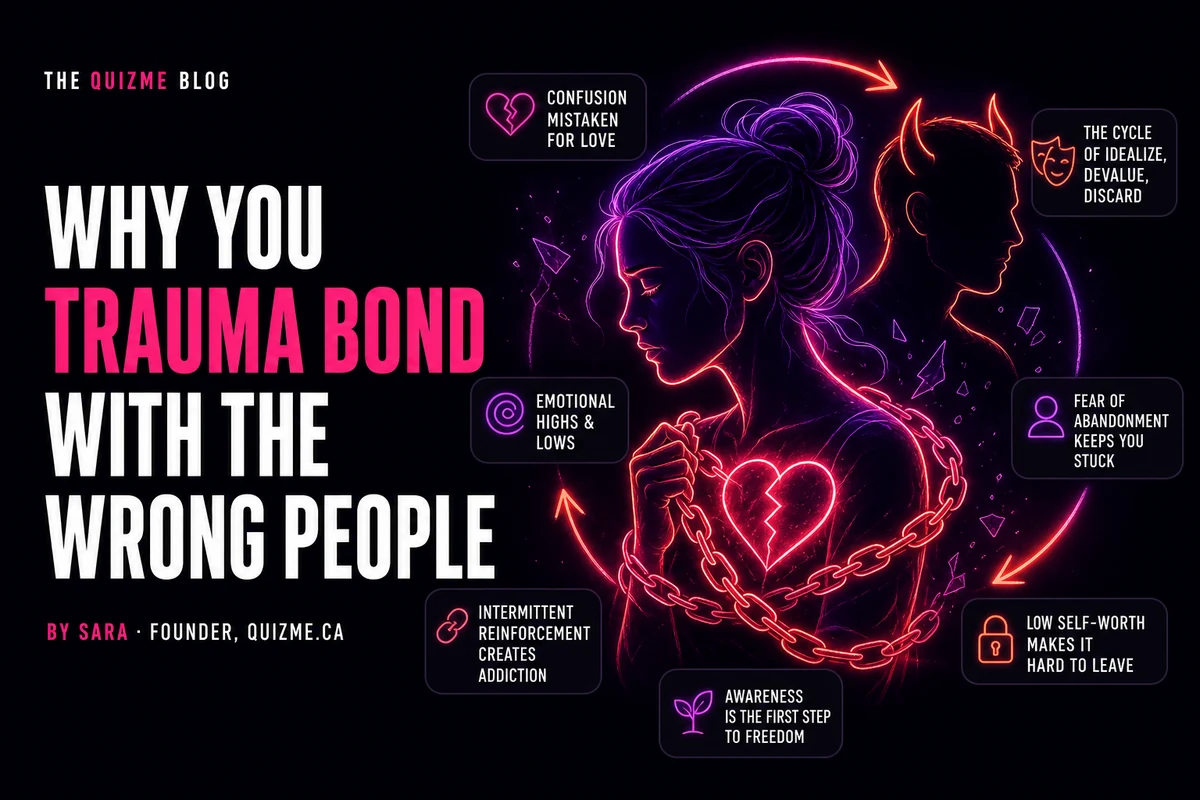
The term emerged from research into abusive relationships. Psychologists Donald Dutton and Susan Painter, studying why survivors of domestic violence so often returned to their abusers, identified a pattern they called “traumatic bonding.” The bond wasn’t random. It formed under two specific conditions: a power imbalance between partners, and intermittent abuse punctuated by periods of warmth, remorse, or apparent closeness. The worse the contrast between the bad times and the good times, the stronger the bond became.
This runs exactly counter to common sense. Most people assume that the more someone hurts you, the less you’d want to be near them. But the nervous system doesn’t work that way. When safety and threat come from the same source, something strange happens in the brain’s reward circuitry. The unpredictability of the warm moments makes them feel extraordinary. Relief gets mistaken for love. The return of affection after conflict floods the system with enough emotional intensity that the brain starts to associate that person with a kind of relief it can’t find anywhere else. The relationship becomes its own kind of drug, and withdrawal feels like it might be fatal.
This is not a flaw in your character. It’s a flaw in how the nervous system handles variable reward. B.F. Skinner’s foundational research on reinforcement schedules found that animals responded most intensely and persistently to rewards that came unpredictably, not reliably. A slot machine keeps you pulling the lever far longer than a vending machine does, precisely because you never know when it will pay out. When a person is the slot machine, your brain runs the same program. The payout is connection. The uncertainty is what makes you stay.
What a trauma bond is not: evidence that you love someone too much, proof that you’re broken, or the same thing as a passionate but difficult relationship. Two people who have a painful argument and repair it together are not trauma bonding. A trauma bond requires the cycle: tension, explosion or withdrawal, reconciliation, calm, then tension again. The cycle is the engine. Without the cycle, there’s no bond in this specific sense.
Why Your Attachment History Wrote This Script
Trauma bonding doesn’t appear out of nowhere. For most people, its roots reach back much further than their current relationship. John Bowlby’s foundational work in the 1960s and 70s proposed that humans are wired from birth to seek proximity to caregivers as a survival strategy. We don’t learn to attach, we’re built for it. What we learn is how to attach, based on whether our earliest caregivers were reliably safe, inconsistently safe, or frightening. That early learning becomes what attachment researchers call an internal working model: a set of assumptions about whether you are worthy of love and whether other people can be trusted to provide it.
Hazan and Shaver, in their landmark 1987 research, demonstrated that these infant attachment patterns show up directly in adult romantic relationships.1 The anxious infant who clung harder when the caregiver was inconsistent becomes the adult who tolerates more, pushes less, and stays longer in relationships where love is rationed. Around 20% of people develop this anxious attachment style, according to Hazan and Shaver’s research, and it originates specifically in unpredictable or emotionally inconsistent caregiving.1 If someone warm became someone cold without warning when you were small, your nervous system learned to treat unpredictability as normal. It may even have learned to treat it as intimacy.
By 1991, Bartholomew and Horowitz had refined the model further, mapping four adult attachment styles onto two dimensions: how positively you see yourself, and how positively you see others.2 The style most tightly linked to trauma bonding is the fearful-avoidant, or disorganized, style. Fearful-avoidant adults hold a negative view of both themselves and others. They want closeness desperately and mistrust it completely at the same time. They are most likely to have experienced early environments where the source of safety and the source of fear were the same person. When that pattern is already in the nervous system, a relationship that oscillates between warmth and threat doesn’t feel alarming. It feels oddly familiar. As the attachment style you didn’t know you had explains, the fearful-avoidant pattern is the one with nowhere safe to go, and it’s the one that makes trauma bonds most likely to take hold.
It’s worth naming the limitation here: not everyone who trauma bonds has a disorganized attachment style, and not everyone with a disorganized attachment style ends up in a trauma bond. Attachment style is a predisposition, not a destiny. Secure people can get caught in abusive cycles too, especially when the relationship begins before the pattern becomes visible. The attachment lens explains vulnerability, not inevitability.
The Partner Who Pulls You In
Trauma bonding doesn’t happen alone. The dynamic requires a particular kind of partner, one who cycles, consciously or not, between pursuit and withdrawal, warmth and coldness, idealization and contempt. Understanding who tends to create these conditions isn’t about blame. It’s about pattern recognition.
Research on the dark triad, the cluster of narcissism, Machiavellianism, and subclinical psychopathy first described by Delroy Paulhus and Kevin Williams in 2002, is relevant here.3 People who score high on these traits tend to engage in what researchers describe as an accelerated mating strategy: intense early pursuit, more sexual partners, mate poaching, and a preference for short-term connection over sustained investment.3 The early phase of a relationship with a high-narcissism partner often looks extraordinary. It’s called love bombing for a reason: the attention, the intensity, the feeling of being truly seen. That early flood is what the brain returns to when things go wrong. You’re not chasing the person they became. You’re chasing the person they were in month one, who may have been a performance specifically designed to create exactly this longing.
This is also where emotionally unavailable partners do their particular damage. Emotional unavailability doesn’t always announce itself. It wears the costume of mystery, independence, not being “too much,” or needing space. For someone whose nervous system learned to work hard for inconsistent love, an emotionally unavailable person feels like a familiar challenge rather than a warning sign. The pursuit feels meaningful. The moments of warmth feel earned. The anxious-avoidant chase is one of the most common and most miserable relationship patterns in existence, and it’s powered by the same intermittent reinforcement engine as every trauma bond.
Again, the limitation: not every emotionally unavailable person is exploitative, and not every high dark-triad individual intends to create a trauma bond. Some people are simply avoidant because they were never taught to be otherwise. Pattern recognition is about understanding the dynamic, not prosecuting the other person’s intentions.
Feeling called out? Take the Attachment Style quiz, it takes about 3 minutes.
Trauma Bond vs. Love: Four Ways to Tell the Difference
1. Notice Whether the Good Feeling Is Relief or Warmth
One of the clearest diagnostic questions you can ask yourself is: when things are good between us, what does it actually feel like? In genuine intimacy, the good moments feel like warmth, security, and ease. In a trauma bond, the good moments often feel like relief. The tension lifts. The fear of losing them subsides. The anxiety quiets for a moment. Relief and happiness can feel identical from the inside, but they have completely different sources. Relief is the absence of threat. Warmth is the presence of safety. Try sitting with that distinction the next time things feel okay between you. If the primary feeling is “thank god,” rather than “this is good,” that’s worth paying attention to. You can do this without drama: just notice the internal texture of the moment. Is your body relaxing because you feel safe, or because the alarm temporarily stopped?
2. Track the Cycle, Not Just the Low Points
Most people in trauma-bonded relationships focus on the bad moments as evidence of what’s wrong. But the cycle is the tell, not any individual episode. Write out the last three times things went badly and the three times that followed, when things were briefly okay. Look for the pattern: tension building, rupture or withdrawal, reconciliation, peace, then tension building again. In healthy relationships, conflict happens and gets resolved. The pattern doesn’t repeat like clockwork. In a trauma bond, the cycle is remarkably consistent in its rhythm. If you can predict the good phase almost as easily as the bad one, you’re probably living in a cycle rather than a relationship. Seeing the cycle from the outside, written down and time-stamped, is a different experience than feeling it from the inside.
3. Ask What You’d Be Without the Anxiety
Trauma bonds often produce a kind of psychological merger that’s hard to distinguish from deep love. The relationship occupies so much mental space that it becomes the organizing structure of your day. The person you can’t stop thinking about might be someone you love, or they might be someone whose behavior your nervous system is constantly trying to predict, prepare for, or manage. The question to ask is: if there were no uncertainty, no hot-and-cold, no need to decode or brace for what’s coming, would the relationship still feel compelling? Would you still want to be in it? Sometimes the answer is genuinely yes, and that matters. But often, when people imagine the absence of the anxiety, they realize the relationship has very little left once the nervous system calms down. The pull was the anxiety, not the person.
4. Check the Direction of Your Self-Worth
In genuine love, your partner’s opinion of you is meaningful but not the only data point you trust. You still have access to your own sense of who you are. In a trauma bond, the bonded partner’s approval becomes disproportionately central to your self-concept. Good day, bad day: it all runs through how they treated you. People will sometimes notice this externally before you notice it yourself. You might have stopped mentioning things that are going well in your life because they didn’t respond warmly. You may have quietly shrunk interests, friendships, or opinions that didn’t get validated. This isn’t love making you devoted. It’s a stress response making you adaptive. The two feel similar and move in opposite directions.
The Pitfall: Thinking You Can Think Your Way Out
Here is the part that most articles about trauma bonding skip, and it’s the most important one: knowing that you’re in a trauma bond does not automatically undo it. This is not a failure of intelligence or willpower. The trauma bond lives in the body’s threat-response system, not in the prefrontal cortex where logical analysis happens. You can understand exactly why you feel the way you feel and still feel it. Understanding is the first step, not the final one.
This is why people say “I know it’s bad for me, but I can’t leave,” and mean it, and are not in denial. The bond is physiological. When you’re separated from a trauma-bonded partner, the nervous system produces something that resembles withdrawal. The stress hormones that were constantly activated by the relationship’s chaos are suddenly absent. The brain, which had calibrated to that level of arousal, interprets the calm as danger rather than peace. Stillness starts to feel wrong.
The trauma bond doesn’t break when you understand it. It breaks when your nervous system learns, slowly, that safety is not the same thing as boredom, and that the absence of anxiety is not the same thing as the absence of love.
The practical implication: insight needs support. Therapy, particularly approaches that work with the body’s stress response, is genuinely useful here in a way that journaling and podcast-listening, however valuable, are not. The nervous system needs new experiences, not just new information. That process takes time, which is frustrating, and it’s real, which is hopeful. If you’ve found yourself in patterns like this more than once, exploring the broader landscape of relationship psychology tends to be more clarifying than any single framework alone.
What Self-Knowledge Is Actually For
There’s a version of psychological self-awareness that becomes its own trap: you learn the names of all your patterns, you can explain your attachment style in a single paragraph, you know what happened in your childhood and exactly how it maps onto your current behavior, and none of it changes anything. The knowledge becomes a more sophisticated story rather than a lever for change. That version of self-knowledge is comfortable and mostly useless.
The version that actually helps is the kind that creates distance between stimulus and response. Not the distance of detachment, but the distance of recognition. “I am feeling the pull to text them because the withdrawal phase just started and my nervous system is in panic mode” is a different experience than just sending the text. It doesn’t guarantee you won’t send it. But the small gap between the impulse and the action is where change is possible. That gap is what you’re building when you understand trauma bonding. Not immunity, just the ability to pause long enough to choose.
Self-knowledge also works retroactively. If you look back at a relationship that baffled you and recognize a trauma bond dynamic, you get to stop narrating it as a story about your failures. You weren’t too sensitive, too needy, too slow to leave, or too stupid to see what was happening. You were operating with a nervous system that had been wired, long before this relationship began, to attach exactly the way it attached. That’s not an excuse. It’s an explanation with implications for what you do next.
Understanding what happened to you is not the same as excusing it. It’s the beginning of making sure it’s not the only story you know how to live in.
Where to Start If This Landed
If this article described something you recognize, the most useful next step is not to immediately label your relationship and make a dramatic decision. It’s to get curious. Curiosity is far more sustainable than self-criticism, and it tends to produce clearer information.
Start by understanding your attachment baseline. The patterns that make trauma bonds possible are attachment patterns, and knowing your attachment style is genuinely clarifying. It’s not a verdict on whether you’re capable of healthy love. It’s a map of the terrain your nervous system is working with. From that foundation, you can start to notice the specific ways your patterns interact with the people you choose.
If you’ve found yourself returning to the same dynamics across different people, the attachment lens is usually more illuminating than any personality typing system. The Big Five and MBTI are genuinely useful frameworks for understanding stable traits. But trauma bonding lives in the relational space between people, not in individual personality profiles. The question isn’t just who you are. It’s what gets activated in you by certain kinds of people, and whether that activation is leading you somewhere you actually want to go.
That question, taken seriously, is not a small one. It tends to reorganize quite a lot. And it starts, as most things do, with being honest about what you already know.
1 Hazan, C., &, Shaver, P. (1987). Romantic love conceptualized as an attachment process. Journal of Personality and Social Psychology, 52(3), 511, 524. 2 Bartholomew, K., &, Horowitz, L. M. (1991). Attachment styles among young adults: A test of a four-category model. Journal of Personality and Social Psychology, 61(2), 226, 244. 3 Paulhus, D. L., &, Williams, K. M. (2002). The dark triad of personality: Narcissism, Machiavellianism, and psychopathy. Journal of Research in Personality, 36(6), 556, 563.