
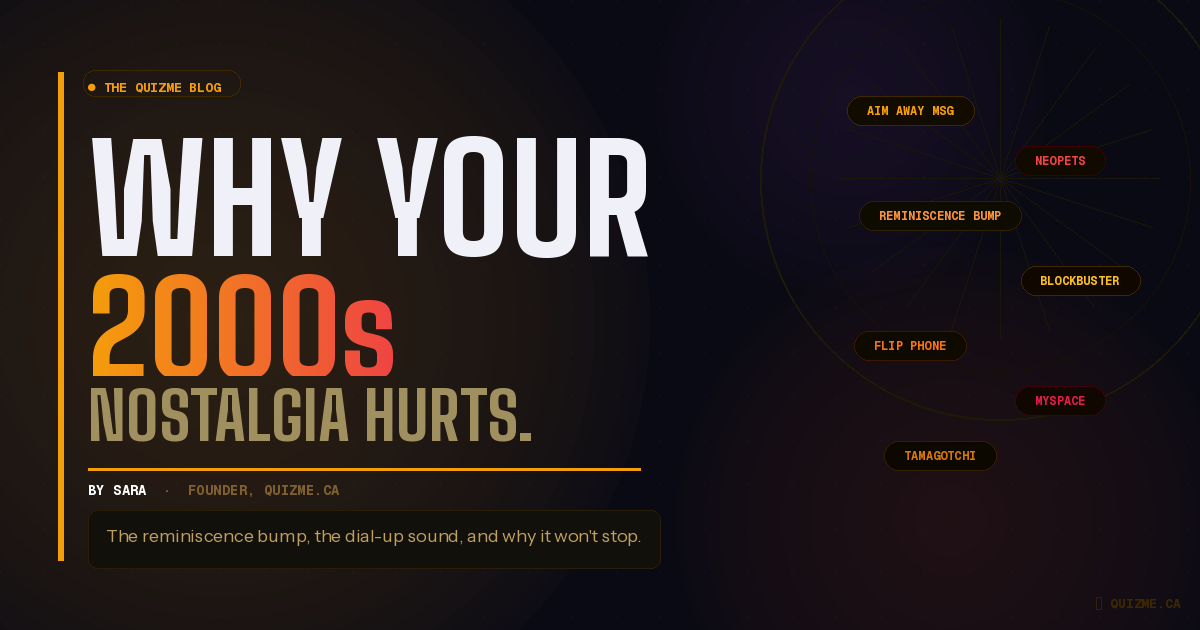
You know the specific feeling. Something triggers it and it arrives fully formed: the dial-up sound, a song from a mid-budget 2003 film, the Neopets load screen, the precise weight of a flip phone in your hand. It is not quite memory and it is not quite grief. It is the specific ache of something you loved without knowing you would miss it.
The 2000s nostalgia wave is not slowing down. If anything, in 2024 and 2025 it accelerated. Y2K fashion is on every runway. Early 2000s pop artists are selling out arena tours. Blockbuster content is everywhere despite Blockbuster not being. The internet is flooded with people asking whether AIM away messages were the most honest form of emotional self-expression ever invented (they were). And somewhere in your body, every one of these references is landing with more force than seems reasonable for objects and experiences you thought you had forgotten entirely.
There is a reason this is happening. Several, actually, and they are all genuinely interesting.
The Reminiscence Bump Is Not What You Think It Is
Psychologists have a name for the period of life that generates our most vivid, most emotionally charged memories. They call it the reminiscence bump. First identified formally in 1986 by researchers Rubin, Wetzler and Nebes, it describes the period between roughly ages ten and thirty where human autobiographical memory is most active, most saturated, and most self-defining. When adults over forty are asked to recall significant memories, a disproportionate number cluster in this window.
The math is simple: the oldest millennials are in their early forties now. Their reminiscence bump lands squarely in the 1990s and 2000s. But the psychological reality of the bump is more interesting than the calendar math.
“Our power to encode lasting memories is strongest in late adolescence and early adulthood. This is when we are building the stories we will use to understand ourselves for the rest of our lives.”, Reminiscence bump research, Association for Psychological Science
The bump is not just a matter of better memory storage. Research by Annette Bohn and Dorthe Berntsen at Aarhus University challenged the purely biological explanation by asking schoolchildren aged ten to fourteen to write their life stories, including future events. The children’s imagined futures clustered around young adulthood, the same period the bump describes in older adults, which suggested the bump was not only about how the brain encodes information. It was about how we culturally and narratively understand which period of life is supposed to matter.
Your 2000s nostalgia is not just about memory retention. It is about identity construction. Those years, those specific songs and shows and rituals, are the raw material from which you built the first version of yourself that felt real.
The Internet Specifically
Here is what makes 2000s nostalgia different from every previous era of cultural backward-gazing: it is the last childhood experienced before constant connectivity, and the first one that left a digital record. Both halves of that sentence matter.
The pre-smartphone era of the early 2000s had a quality of attention that is genuinely difficult to recreate now. You could not be reached everywhere. Plans were made and kept or they fell apart irretrievably. The Blockbuster trip was a ritual because it was one of a finite number of options and rituals require constraints. You memorised phone numbers because you had to. Your AIM profile was curated because it was your only platform, which made it carry a weight of self-expression that no single social media post can approximate today.
📼 A specific thing about music
Research by Kelly Jakubowski at Durham University found the music-related reminiscence bump peaks at around age 14. Songs that were popular when you were fourteen evoke more autobiographical memories than songs from any other period of your life. If you were fourteen in 2003, this explains a great deal about your relationship with Nelly Furtado.
And simultaneously: the early internet left evidence. Your Myspace existed. Screenshots of MSN Messenger conversations survive somewhere. Early YouTube videos are still up. The era is archived in a way no previous childhood was, which means the nostalgia is not purely imaginative. It is recoverable. You can actually go back, which makes the longing stranger, more specific, and sometimes more painful than nostalgia for things that are truly gone.
What Your Specific Nostalgia Object Reveals
Nostalgia researcher Constantine Sedikides at the University of Southampton has spent twenty years studying what nostalgia actually does. His findings are consistently surprising: nostalgia is not primarily about the past. It is a present-moment regulation tool. People turn to it when they feel lonely, when meaning is depleted, when the present feels unclear or difficult. Nostalgia spikes during uncertainty specifically.
Which means the thing you keep thinking about, the specific object or show or song or ritual that your brain returns to, is not randomly selected. It is strategically chosen by your nervous system because it offers something you need right now. The nostalgia content is a clue to the present deficit.
People nostalgic for Saturday morning cartoon rituals often miss predictable structure. People nostalgic for AIM often miss a time when communication required intention and effort and therefore meant more. People who cannot stop thinking about specific school lunches miss the enforced community of a shared physical space. People obsessed with specific pop stars from the era are often grieving a version of aspiration that felt possible and uncomplicated.
None of this is diagnosis. It is observation. But observation, in the right direction, points somewhere useful.
Gen Z’s Relationship with an Era They Never Had
One of the stranger dimensions of the current 2000s revival is that it is not solely driven by people who lived through it. Research from the University of Pittsburgh on “vicarious nostalgia” found that Gen Z consumers, born into a world of constant connectivity, experience a longing for an analogue era they technically never experienced. Living through a period defined by information overload and perpetual digital presence, they are drawn to the aesthetics of a time that offered bounded experience, slower pace, and clear separation between being online and being in the world.
They are nostalgic for a version of childhood they read about, inherited secondhand, or encounter through cultural artefacts. Which makes 2000s nostalgia unusual: it functions as both personal memory and shared mythology simultaneously.
The Good Kind of Going Back
Sedikides distinguishes between two types of nostalgia that matter here. Reflective nostalgia treats the past as a resource, something to draw energy and continuity from without demanding that you actually live there. Restorative nostalgia tries to rebuild the past exactly, treating the present as a deficiency rather than a continuation. The first is healthy. The second gets complicated.
Most casual 2000s nostalgia, the kind that makes you watch Lizzie McGuire at 11pm or spend forty-five minutes on a Neopets Reddit thread, sits comfortably in the healthy range. You are not refusing to leave. You are visiting. You are taking something the past has to offer and bringing it back to Tuesday.
And if you want to find out which specific 2000s cultural object your personality most closely resembles, which early internet era you truly belong to, or what your hypothetical AIM away message would have said and what that reveals about who you are now, well. That is precisely what we built the nostalgia quiz category for.
📼 Take the Nostalgia Quizzes →