

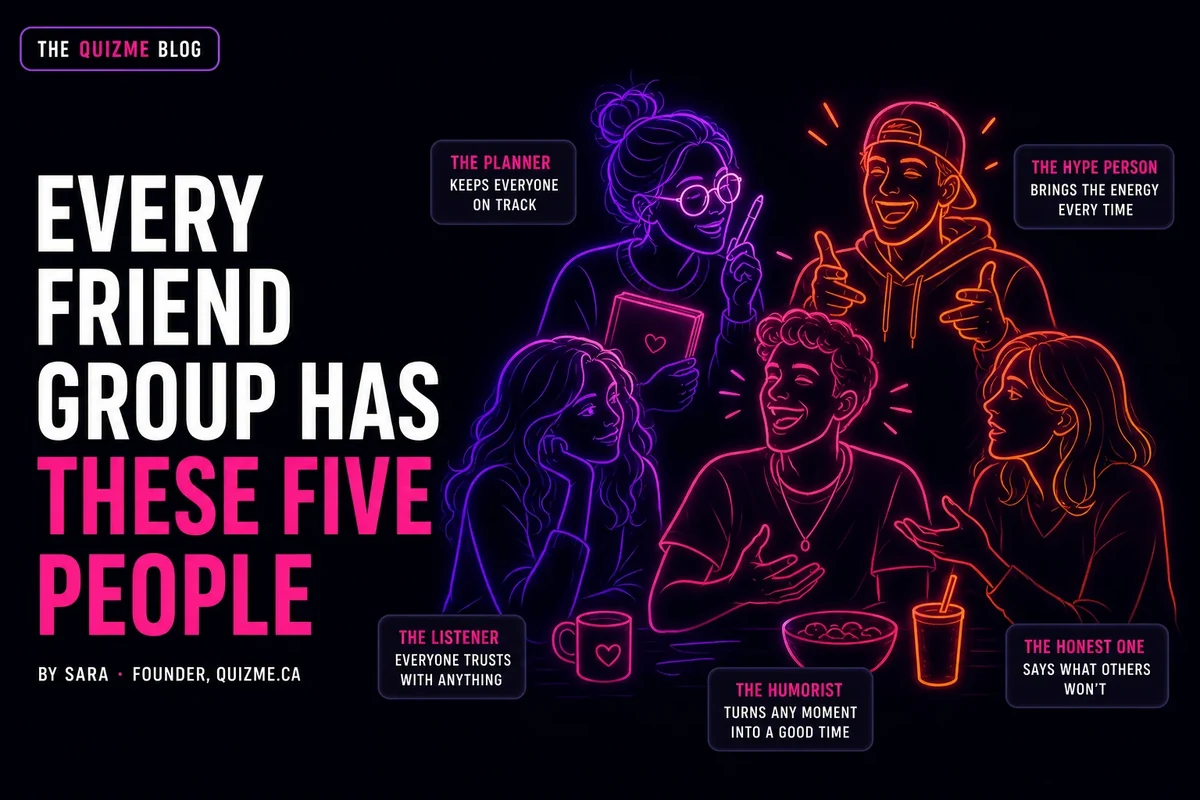
Every group of friends has the same five people in it. Not the same faces, not the same names, but the same roles. The one who already made a reservation before anyone else texted back. The one who shows up with a theory about the restaurant’s vibe before they’ve even ordered. The one who quietly makes sure everyone feels included while the other two are debating where to sit. The one who’s been in a situationship for six months and has the receipts to prove it. And the one who planned an entirely different evening but somehow ended up here anyway, having a surprisingly great time. You know all five of these people. You might be one of them. And according to the Big Five personality model, the most rigorously tested framework in personality psychology, this is not a coincidence. Friend group dynamics tend to self-sort along the same five psychological dimensions, every single time.
Why the Big Five Shows Up in Your Group Chat
The Big Five, also called OCEAN (Openness, Conscientiousness, Extraversion, Agreeableness, Neuroticism), didn’t come from a startup quiz or a wellness influencer. It emerged from decades of overlapping research, most notably formalized by McCrae and Costa, who confirmed the model’s validity and gave us the structure still used today. The core finding was almost anti-climactic: if you took every personality-describing word in the English language and ran the statistical patterns, you’d keep landing on five clusters. Not sixteen types. Not nine archetypes. Five.
What makes the Big Five useful for understanding friend groups specifically is that these traits don’t just describe individuals in isolation. They predict how people behave in social situations: who initiates, who mediates, who catastrophizes, who disappears into their own head, and who holds the whole thing together through sheer warmth. High extraversion consistently predicts stronger social networks, high agreeableness ties to cooperative and harmonizing behavior in groups, and neuroticism predicts who texts “are you sure you’re not mad at me?” at 1am. You’ve met all of these people. Let’s put names to the patterns. If you want to go deeper on the full personality psychology behind these traits, that’s a rabbit hole worth falling into.
Your group chat isn’t random. It’s a personality distribution that assembled itself, slowly, because each of these five roles makes the group more resilient than any one person could on their own.
The Five Roles, Decoded
1. The Organizer: High Conscientiousness
This is the friend who already has a Google Doc for the group trip. They booked the Airbnb two months out, sent a shared itinerary, and followed up when nobody responded to the packing list. They show up on time and quietly seethe when no one else does, though they’d never say that out loud. High conscientiousness, defined by researchers as self-discipline, organization, carefulness, and goal-directed behavior, is the trait that keeps your group from falling apart logistically. Without The Organizer, plans stay in the aspirational stage forever. Research links conscientiousness to greater reliability, higher follow-through, and stronger performance in structured environments. The Organizer is not a control freak. They’re carrying something the group outsourced to them without asking.
The shadow side: conscientious people can tip into rigidity. When the plan changes, The Organizer is often the last one to pivot gracefully. They also tend to notice when they’re the only one putting in the effort, and they quietly accumulate resentment about it for about six months before saying anything.
2. The Visionary: High Openness to Experience
This is the friend who has three half-finished creative projects, a rotating obsession (currently fermentation, previously Norwegian crime fiction), and a habit of reframing any conversation into something slightly more cosmic than the group was ready for. High openness reflects curiosity, imagination, intellectual depth, and a genuine appetite for novelty. Personality research has linked it to creative innovation, a tendency toward exploratory thinking, and lower rates of loneliness, possibly because highly open people are genuinely interested in other people’s inner worlds, which makes them magnetic in small doses.
The Visionary is the one who suggests the karaoke bar nobody would have thought of, books a last-minute flight to somewhere cold for a reason they can’t fully explain, and sends the article at midnight that changes how you think about something. They are also chronically over-committed, mildly allergic to routine, and occasionally exhausting when you just wanted to watch something comforting. Notably, openness to experience is positively related to individual proactivity but can work against group cohesion when everyone else needs to land the plane and The Visionary wants to redesign the airport.
3. The Glue: High Agreeableness
This is the friend you would call first if you had genuinely bad news, not because they’d have the best advice, but because they’d make you feel immediately less alone. High agreeableness describes kindness, warmth, and a deep orientation toward cooperation and the feelings of others. The Glue is the one who checks in after you seemed quieter than usual in the group chat. They’re the person who notices when two friends are in a cold war and gently, expertly, brokers a détente without making it a thing.
What often gets skipped in cheerful descriptions of agreeableness is the cost attached. Highly agreeable people are prone to conflict avoidance, sometimes to a degree that works against their own interests. They absorb tension so the group doesn’t have to, which is generous right up until it becomes a pattern of self-erasure. The Glue can also be quietly keeping score of who asked how they were doing, and that spreadsheet is longer than anyone realizes. If you’ve never asked The Glue how they’re doing, consider this your nudge. They’ve been fine in a way that costs something.
4. The Feeler: High Neuroticism
This is the friend who experienced the situation most intensely and will still be processing it six weeks later. High neuroticism, or emotional volatility, describes a tendency toward worry, mood swings, and heightened sensitivity to stress. Personality research has linked it to more frequent experiences of anxiety, stronger responses to perceived social threats, and a greater tendency to ruminate. Neuroticism also predicts stronger socialization motives: individuals who score high here often reach out more, share more, and invest emotionally in ways that can make them extraordinarily present in a friendship.
The Feeler is not a burden. They’re the reason the group actually talks about feelings instead of just trading memes for three years. They bring emotional depth to conversations that would otherwise stay surface-level. They also sometimes derail group dinners with a level of introspection nobody budgeted for. The Feeler is at their best when the group has the capacity to receive them. When it doesn’t, they feel it acutely, and they’ll definitely bring it up later, at length, which is either annoying or exactly what you needed, depending on the week.
5. The Spark: High Extraversion
This is the friend who walked into a party where they knew three people and somehow left knowing forty. They are energized, not just unbothered, by social situations, and that energy is contagious. High extraversion is associated with increased activity in the brain’s dopamine reward system, which is why extraverted people aren’t faking their enthusiasm for crowds: they’re genuinely getting something from it that introverts are not. They’re more likely to initiate events, emerge as informal leaders, and build broader social networks. Research by Asendorpf and Wilpers found that extraversion predicts stronger social capital and more robust support systems over time.
The Spark is the one who made the group chat in the first place, who texts “we’re doing something this weekend, yes?” and makes it non-negotiable in the best way. The catch: extraverted people consistently get rated as worse listeners in social perception research. The Spark is great at generating social momentum and sometimes not great at sitting still in the quiet moments. They can fill silences that didn’t need filling and occasionally mistake energy for connection.
Feeling called out? Take the personality map quiz, it takes about 3 minutes.
Why Your Group Needs All Five (Even the Annoying One)
The reason every enduring friend group tends to have some version of these five roles is not coincidence or social fate. It’s closer to self-selection for complementarity. Groups where everyone is high in extraversion and low in conscientiousness have great vibes and no reservations. Groups where everyone is highly conscientious and low in openness book vacations to the same place every year and eat at the same restaurant because it was fine last time. Groups made up entirely of high neuroticism individuals produce group chats so active with collective anxiety that turning off notifications becomes a mental health necessity.
The friction between personality types is, irritatingly, the point. The Organizer grounds The Visionary’s ideas into actual plans. The Glue absorbs the tension when The Spark’s confidence lands sideways. The Feeler names the thing everyone in the group has been tiptoeing around for a month. No single trait makes a complete friend group. What matters is the distribution, and the willingness of each person to understand their own role well enough to manage its shadow side. That’s where personality awareness becomes practically useful, not just interesting.
One important caveat: these roles are tendencies, not destinies. The Big Five measures personality as a spectrum, not a set of fixed types. Most people sit near the middle on most traits, which means most people flex into different roles depending on the group. Someone who’s The Glue with one set of friends is The Spark with another. The role you’re typed into says as much about the group’s existing configuration as it does about you.
The Common Mistake Every Friend Group Makes
The mistake is confusing the role for the person. Once someone becomes The Organizer, the group stops asking if they want to be. Once The Feeler brings intense energy to three consecutive conversations, they get quietly assigned that identity and anything they share that’s lighter or more trivial gets treated as a pleasant surprise. The Glue gets taken for granted so consistently that social support research suggests they’re at higher risk of friendship burnout specifically because their labor is least visible.
The other version of this mistake is pathologizing one trait while quietly depending on it. Groups that roll their eyes at The Feeler’s intensity are often also the first to call The Feeler when something genuinely difficult happens, because they know The Feeler will show up fully. Groups that tease The Organizer for being uptight are relying entirely on The Organizer’s uptightness to have anywhere to go on Saturday night. If you’re in a group that benefits from someone’s trait but treats that trait as a punchline, that’s worth sitting with. You can find a gentle version of this dynamic in almost every long-term friend group, and naming it out loud is often enough to shift it.
There’s also the question of what happens when a role goes unfilled. If your group is missing The Glue, the unspoken conflicts tend to calcify. Missing The Organizer means plans collapse into endless “we should really do something soon” texts. Groups that lack any high-openness energy can stagnate into comfortable but ultimately boring patterns. The dynamics that drain friendships often trace back to a structural imbalance, where one person has been playing two roles simultaneously, quietly, for years.
What Knowing Your Role Actually Changes
Self-knowledge isn’t just about understanding yourself in isolation. It’s about understanding what you bring to the specific people around you, and what it costs you to keep bringing it.
The Big Five model is most useful not as a mirror but as a relational map. If you score high on neuroticism, that awareness doesn’t just tell you something about your internal experience. It tells you something about where your friendships are likely to get complicated: when your need for reassurance outpaces what the group can offer, when you interpret silence as abandonment, when you bring an intensity to casual plans that leaves everyone feeling vaguely guilty. That awareness is the first step toward managing the shadow side of the trait instead of letting it manage you.
If you’re The Organizer, knowing that conscientiousness correlates with accumulating unspoken resentment is genuinely useful. It gives you a framework to address the imbalance before it becomes a quiet grievance. If you’re The Spark, knowing that extraversion predicts worse listening scores is not a character indictment. It’s an invitation to practice. If you’re The Glue, understanding that agreeableness can tip into self-erasure might be the most important thing anyone has told you about your friendships in years.
The Big Five is stable across adult life, which means these tendencies aren’t going anywhere. What changes is your relationship to them: whether you lead with the strength or get ambushed by the shadow. Understanding where you sit on each of these dimensions, and where your friends sit, is not about labeling people or excusing behavior. It’s about seeing clearly enough to actually choose, rather than react. If you’re curious how these traits play out at work, personality and work fit follow the same logic, and the friction points are remarkably similar.
Figure Out Where You Actually Fall
The easiest place to start is with what irritates you most about your friend group’s patterns, because your irritation is almost always personality-adjacent. The person who finds the constant replanning frustrating is probably high in conscientiousness. The person most annoyed by shallow conversation is probably high in openness. The person who gets quiet when the group skips a week of hanging out is probably high in neuroticism. Your friction points map to your traits more reliably than your best self-descriptions do.
From there, personality tests are a surprisingly good starting point, not because the results are final, but because they give you vocabulary for patterns you’ve already noticed. If you’ve ever felt like you understand everyone in your group better than they understand you, you might be The Glue. If you’ve ever been called “a lot” by someone who then called you when their life fell apart, you’re probably The Feeler. If you’ve been the one forwarding this article with a “tag yourself” caption, you already know who you are.
For a deeper look at how all five traits interact in your own personality profile, the full Big Five breakdown covers every dimension with more nuance than a friend group listicle can hold. And if some of the relationship dynamics in your friend group feel less like personality friction and more like a long-established pattern with its own gravitational pull, the piece on what keeps us in imbalanced friendships is worth reading next. Sometimes the role you play in your friend group is less about who you are and more about who you learned to be, and those are very different starting points for change.