

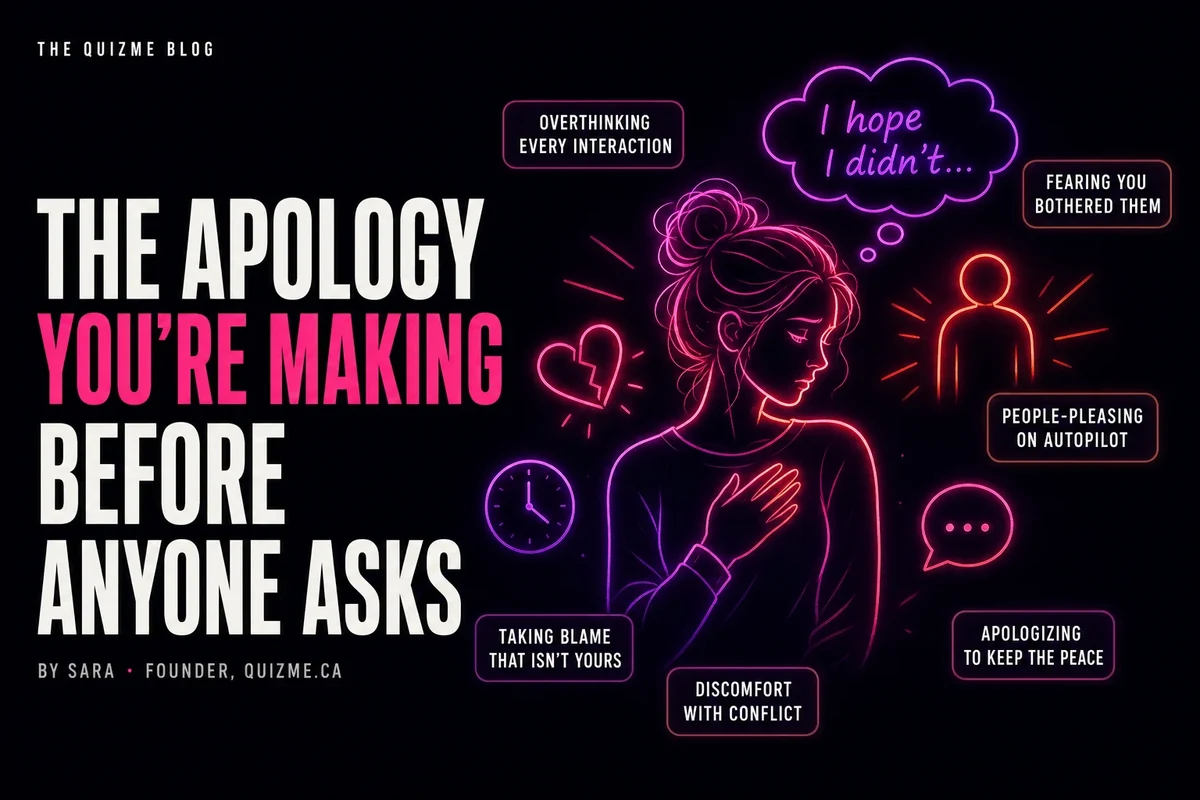
You send the text, then immediately send three more explaining the first one. You turn down a dinner invitation and spend six sentences telling someone why, as though they were your judge. You make a decision at work, feel fine about it, and then spend the next hour mentally rehearsing your defense for a conversation that hasn’t happened. Nobody asked. Nothing went wrong. But your nervous system is treating ordinary life like a courtroom, and you are perpetually on trial.
Over-explaining is one of those behaviors that sounds harmless, maybe even considerate, until you notice how exhausting it is. Not just for the people around you, but for you. The constant pre-justification, the reflexive sorry before you’ve done anything wrong, the way a simple “I can’t make it” turns into a paragraph-long deposition. You’re not doing it because you’re verbose. You’re doing it because, somewhere in your history, not explaining yourself cost you something.
What Over-Explaining Actually Is (It Isn’t Just Anxiety)
Most articles about this topic will lead with “you have anxious attachment” or “you’re a people-pleaser” and call it done. But the behavior itself is worth examining first, because it tells you something specific about where the fear lives.
Over-explaining is a preemptive defense. It’s what happens when your nervous system has learned that your choices, your feelings, and your very presence require justification in order to be safe. You learned, at some point, that conflict or disapproval didn’t just feel bad: it felt threatening. And when something feels threatening, the brain starts running interference before the threat actually arrives.
The clinical framework that describes this most precisely is called the fawn response, a concept developed by trauma therapist Pete Walker in his work on complex PTSD. Walker identified four survival responses to perceived threat: fight, flight, freeze, and fawn. Most people are familiar with the first three. The fourth is the one that looks like niceness. Fawning is the strategy of managing a perceived threat by becoming as agreeable, helpful, and unthreatening as possible. Where fight says “I’ll push back,” fawn says “let me make sure you have no reason to push back first.”
Over-explaining is fawn in sentence form. Every paragraph you add to a simple message is a small act of threat management. You’re not sharing information. You’re removing reasons for someone to be upset with you.
Why Anxious Attachment Turns Up the Volume
The fawn response describes the mechanism. Anxious attachment describes the underlying wiring that makes the mechanism fire so easily.
Attachment theory, developed by John Bowlby and later extended to adult relationships by researchers Cindy Hazan and Phillip Shaver, proposes that the emotional blueprint you built from your earliest caregiving relationships becomes the template for how you operate in all close relationships afterward. Bowlby described this as an internal working model: a set of deep, mostly unconscious expectations about whether you are worthy of love and whether other people are reliably safe to depend on.
For people with anxious attachment, that working model tends to hold a negative view of the self and a mixed, apprehensive view of others. Research on anxious attachment consistently finds that the attachment system in these individuals is prone to hyperactivation under stress: emotions amplify, threat-detection runs hot, and the pull toward reassurance becomes almost impossible to ignore.1 Anxiously attached adults crave closeness and emotional confirmation, but they hold a persistent fear that it will be withdrawn.
That fear is what makes over-explaining feel so urgent. When you’re hyperactivating, a neutral tone in a text message reads as coldness. Silence reads as anger. Someone taking a few hours to reply reads as the beginning of abandonment. Your nervous system starts broadcasting: do something, say something, explain something, anything to close this gap. So you explain. You justify. You apologize in advance. You give people eleven reasons for a decision that required zero.
Mikulincer and Shaver describe this as a hyperactivating strategy: an effortful attempt to maintain proximity to attachment figures by intensifying emotional signals and communication. The over-explaining isn’t irrational. It’s a strategy that probably worked at some point, in some environment, where visibility and justification actually did protect you from rejection or punishment.
The Childhood Math That No Longer Adds Up
People don’t develop fawn responses or anxious attachment in a vacuum. The patterns form in environments where emotional safety was genuinely unpredictable: a parent whose mood shifted without warning, a household where anger came suddenly and you learned to scan for it constantly, a caregiver who was sometimes warm and sometimes simply not there emotionally. Research on anxious attachment consistently points to inconsistent caregiving as a primary origin point: the child’s needs are met sometimes, ignored other times, with no reliable pattern. The unpredictability is the problem, not the harshness.
When your primary caregiver was inconsistent rather than reliably safe, you learned that emotional connection was something you had to earn and maintain through behavior. Keeping the peace, staying palatable, explaining yourself clearly enough so that no one had grounds to be upset with you. That was adaptive then. It worked well enough. The difficulty is that the same calculus, running on autopilot in adulthood, applies to your boss, your partner, your friends, the acquaintance who didn’t heart your story. It treats every relationship as though disapproval is the same existential threat it once was.
Anxiously attached children who grow up with this pattern often become adults who are, as clinical psychologist Dr. Kim Sage describes it, “overly sensitive to the world and to others” in ways that hold genuine beauty. That heightened attunement, that care for how others feel, that capacity to read a room before anyone else does: these are real strengths. They become costly when they’re involuntary, when you can’t turn the scanner off even when the room is safe.
Feeling called out? Take the Attachment Style quiz, it takes about 3 minutes.
What It Actually Looks Like Day to Day
The reason this behavior is so easy to miss is that it blends seamlessly into things that look like conscientiousness or kindness. Here are the patterns worth watching for in yourself.
1. The Pre-Apology
You say sorry before anything has gone wrong, or immediately after a request, as though the request itself required penance. “Sorry to bother you, but…” “Sorry, this is probably a stupid question, but…” “Sorry, I know you’re busy…” The apology isn’t expressing genuine remorse. It’s a small tribute paid to the relationship to lower the chance of disapproval. Notice whether you apologize for existing in someone’s space before they’ve indicated they mind.
- Try catching the next preemptive sorry and replacing it with nothing, or with a simple statement.
- Notice how long the urge to apologize lingers after you don’t follow through on it.
2. The Three-Paragraph Text
Someone asks a simple question. You write a simple answer. Then you add context. Then you add a caveat. Then you add a disclaimer about the caveat. By the time you hit send, you’ve turned “I can’t come Thursday” into a documentary. This is often the fawn response in real time: every additional sentence is an attempt to prevent a bad reaction you haven’t actually seen evidence for.
The tell is checking the draft message and asking whether any of the extra content is genuinely useful to the other person, or whether it’s there to manage your own discomfort.
3. Mental Rehearsal of Conversations That Haven’t Happened
You spend time mentally preparing your defense for interactions that exist only in your imagination. You rehearse what you’ll say if your manager questions the decision you made. You plan out exactly how you’ll justify the choice to your partner before they’ve said a word. This is the internal version of over-explaining, and it’s often the most draining because it’s constant. The trial never adjourns. You’re your own prosecutor and defense attorney simultaneously, and neither side ever rests.
- When you catch yourself rehearsing, ask: has this person actually expressed concern, or am I filling in their lines for them?
4. The Phantom Guilt
You feel guilty about things that weren’t your fault, didn’t affect anyone, or that others have already said are fine. A colleague covers for you and you spiral for days. You take a day off and feel the need to justify it to four different people. The guilt arrives before anyone has accused you of anything. This is one of the clearest signs that the inner critic has taken on the voice of an old relationship, not a current one. You’re confessing to a jury that’s not in the room.
5. Shrinking Before Anyone Asks You To
You make yourself smaller, quieter, or less visible in social or professional spaces not because you don’t have something to contribute, but because you’re trying to preempt the possibility of someone objecting to your presence. You qualify your opinions before voicing them. You phrase expertise as questions. The professional cost of this pattern is real: chronically under-assertive communication trains others to see you as less credible, regardless of your actual capability.
- Practice stating a preference or opinion once, without hedging, and observe whether the feared reaction actually materializes.
Where This Pattern Gets Complicated
The honest complication with the fawn response and over-explaining is that it doesn’t map perfectly onto every situation or every person. Not all over-explaining comes from anxious attachment. Some of it comes from neurodivergent communication styles, particularly in autistic individuals who over-explain because neurotypical social rules are genuinely unclear and because they’ve learned through experience that being misread is costly. Some of it comes from perfectionism, the need to cover every angle before anyone else can find a flaw. Some of it comes from working environments or family systems where explanation really was required, and was met with better outcomes.
The anxious attachment and fawn framework is a map, not the territory. It gives you a useful vocabulary for recognizing patterns, but it doesn’t tell the whole story for everyone. If the pattern intensifies only in romantic relationships but not in professional ones, the wiring is probably more about attachment specifically. If it runs equally hot everywhere, including with strangers, the fawn response as a nervous system pattern is more likely the culprit. If it appears only in environments with a clear authority figure, the history might point somewhere more specific in your past.
Not all anxiously attached people over-explain, either. Some go the opposite direction: they withdraw and say nothing, waiting for the other person to notice and repair the distance. Hyperactivation doesn’t always mean more words. Sometimes it looks like silence that’s doing a lot of internal screaming. The two responses share the same root fear, they just express it differently.
The over-explaining is not a character flaw. It’s a translation: your nervous system rendering old fear into current-day sentences, hoping this time the explanation will finally be enough.
The Real Cost of Justifying Everything
There’s a kind of irony built into this pattern. Over-explaining is designed to protect relationships by reducing the chances of conflict or disapproval. But in practice, it frequently has the opposite effect.
When you over-explain constantly, people in your life start to notice, consciously or not, that your communication always arrives pre-packaged with anxiety. Your “no” comes with twelve reasons, which signals that a simple no isn’t something you trust them to accept. Your requests come wrapped in apology, which quietly communicates that you believe your needs are a burden. Over time, that changes how people relate to you: it can attract people who are comfortable with a dynamic where your anxiety does the emotional labor, and it can exhaust people who would genuinely rather you just said the thing.
There’s also a cost to you specifically. Chronic over-explanation keeps you in a permanent low-level state of threat. Your nervous system never fully gets to downregulate, because it’s always anticipating the next moment it might need to explain itself. This is the hyperactivation of the attachment system running not as a temporary alarm but as a baseline setting. That’s exhausting in a way that doesn’t show up on any medical test. It just feels like being tired all the time, like every conversation costs a little more than it should.
If you recognize yourself in this, it’s worth reading about why certain relationship patterns keep repeating despite your best efforts, because the fawn response and anxious attachment rarely operate in isolation. They tend to interact with partner selection in ways that reinforce the original pattern. And for a broader look at how these dynamics play out across all kinds of relationships, the pattern shows up in friendships, family systems, and workplaces just as reliably as it does in romance.
Experiments Worth Running on Yourself
None of this is fixed. The internal working models that Bowlby described are built from experience, and they can be gradually revised through experience. That doesn’t mean you will, or should, become someone who never explains themselves. It means you get to choose when explanation is genuinely useful versus when it’s preemptive threat management dressed as communication.
6. The One-Sentence Rule
For one week, practice ending messages with one sentence fewer than feels comfortable. Not terse. Not rude. Just one fewer. Notice the discomfort, acknowledge it, and send the message anyway. The goal isn’t minimalism. It’s finding out whether the feared reaction actually arrives when you stop over-explaining. In most cases, it won’t. That mild surprise is data your nervous system needs.
7. Tracing the Guilt Back
When phantom guilt arrives, the kind that shows up before any accusation, try asking: whose voice is this? Not figuratively, but literally. If you hear a criticism in your head, notice whether it sounds like a specific person from your history. Much of the inner tribunal that drives over-explaining is populated by old relationships running new lines. Recognizing that the voice isn’t current doesn’t silence it immediately, but it does change your relationship to it.
- Write the criticism down and ask whether a person who actually knew you today would say it.
- If the answer is no, that’s a sign the voice belongs to a past environment, not your present one.
8. The Acceptance Test
Choose one low-stakes interaction this week where you make a request or decline something with no explanation at all. Not “I can’t come because of X, Y, and Z.” Just “I can’t make it, but thank you for the invite.” Then sit with the discomfort that follows. The discomfort is real, and it’s important: it’s your nervous system running its old program and not getting the familiar relief of the explanation. The more times you let that discomfort pass without incident, the more evidence you accumulate that the world doesn’t actually require your constant justification to remain intact.
What Self-Knowledge Is Actually For
Understanding the fawn response and anxious attachment isn’t meant to give you a new identity to perform. The point isn’t to walk around thinking “I fawn, therefore I must constantly monitor my fawn responses” in a way that just becomes a different kind of hypervigilance. It’s to create enough distance between the impulse and the action that you have a choice.
The anxious attachment research is genuinely hopeful on this front. Hazan and Shaver’s framework on adult attachment explicitly allows for change: internal working models are not fixed biological programs. They are updated by repeated experience, by relationships that consistently contradict the old model, and by the accumulation of evidence that safety doesn’t require constant maintenance. People can and do move from more insecure to more secure attachment patterns over time, particularly through consistent relationships and through the kind of self-awareness that lets you recognize the pattern while it’s running.
Knowing why you over-explain doesn’t mean you have to stop caring about people. It means you get to care from a place of choice rather than survival.
Your attunement to others, your ability to sense what they need, your care about how things land: these are qualities worth keeping. The problem isn’t the caring. The problem is when the caring is involuntary, driven by old fear rather than genuine generosity. The difference between those two things matters enormously, and it starts with being able to tell them apart in real time.
Where to Start
If you’ve recognized yourself in the patterns above, the most useful next step is usually getting more specific about where the pattern is strongest. Over-explaining in every context points toward a nervous system pattern. Over-explaining only in romantic relationships points toward attachment style. Over-explaining only around authority figures points toward something more specific in your history. Knowing the shape of it helps you know which direction to work.
The attachment style framework is one of the most practically useful lenses in psychology for understanding your relationship patterns, partly because it describes not just what you do but why, and partly because it comes with a clear direction of travel. If you’re curious where your patterns actually sit, the Attachment Style quiz is a good place to begin. It’s not about labeling yourself. It’s about getting a clearer map of the terrain you’re already living in.
And if the over-explaining pattern shows up most at work, or in contexts where you’re being evaluated, the ways we hide our real selves under performance is a related thread worth pulling on. The behavior looks different in different contexts, but the nervous system running it is usually the same one.
You’re not too much. You’re not too needy. You learned to speak in apologies because, at some point, they kept you safe. The work now is recognizing that you have more tools available than the ones that kept you small.
1 Mikulincer, M., & Shaver, P.R. (2003). The attachment behavioral system in adulthood: Activation, psychodynamics, and interpersonal processes. Advances in Experimental Social Psychology, 35, 53, 152. Referenced via SimplyPsychology.org attachment styles overview.