
You matched with someone great. The conversation was good, maybe even really good. Then they took six hours to reply and your entire nervous system staged a small revolt. You checked their profile activity. You drafted three different follow-up messages and deleted all of them. You told yourself you didn’t even care that much, which was obviously a lie, because here you are, still thinking about it at midnight. Here’s the thing: none of that is about your “commitment issues.”, It’s not about being too sensitive or too online or too deep in your feelings. It’s about attachment, and the way dating apps were designed without a single thought for what Bowlby (1969, 1988) spent decades proving about the human nervous system.
The Attachment Reframe: Your Dating Moves Aren’t Random
John Bowlby’s foundational work on attachment theory proposed something that feels both obvious and genuinely revelatory once you actually sit with it: every human being builds an Internal Working Model in childhood. This is a cognitive template, a kind of mental blueprint, assembled from early caregiving experiences, that shapes how you expect closeness to feel and how you expect people to behave when you need them. Bowlby (1969, 1988) argued that this model doesn’t stay in childhood. It follows you into every significant relationship you ever have, romantic or otherwise.
The reason this matters for modern dating psychology is that the Internal Working Model isn’t passive. It’s running constantly, scanning for signals, making predictions, and triggering emotional responses before your conscious brain has finished processing what just happened. When your match’s typing indicator disappears and the message never comes, you’re not being dramatic. Your nervous system just fired the same proximity-seeking alert it was built to fire when your primary caregiver was unavailable. The context changed. The wiring didn’t.
Hazan and Shaver applied Bowlby’s framework to adult romantic love and identified three measurable attachment patterns: secure, anxious, and avoidant. These aren’t personality types in the MBTI sense. They’re relational strategies, behavioral tendencies that emerge in response to closeness and uncertainty. Understanding which pattern tends to run your dating life is the single most useful piece of self-knowledge you can have before you open an app, and before you understand why you might bond with the wrong people.
How Dating Apps Hijack Your Attachment System
Here’s what an app actually is, stripped of all its branding: an infinite-choice environment with compressed courtship timelines, visible rejection metrics, and built-in ambiguity around every single interaction. Read receipts tell you when someone saw your message without telling you why they didn’t reply. Match counts gamify desirability. The “Super Like”, function makes you briefly visible before returning you to the pile. Every one of these design features activates the same attachment signals that evolved in infancy for a completely different purpose.
The Barnum effect is relevant here too, and it’s sneaky. The Barnum effect describes our tendency to accept vague, general statements as uniquely true about ourselves. Dating profiles are essentially Barnum machines. Six photos and a line about loving hiking and good coffee tells you almost nothing, but your brain projects an entire personality onto it. You feel like you know someone after one good conversation. Then they go quiet and the silence feels personal, even when it probably isn’t, because you’ve already filled in all the blanks.
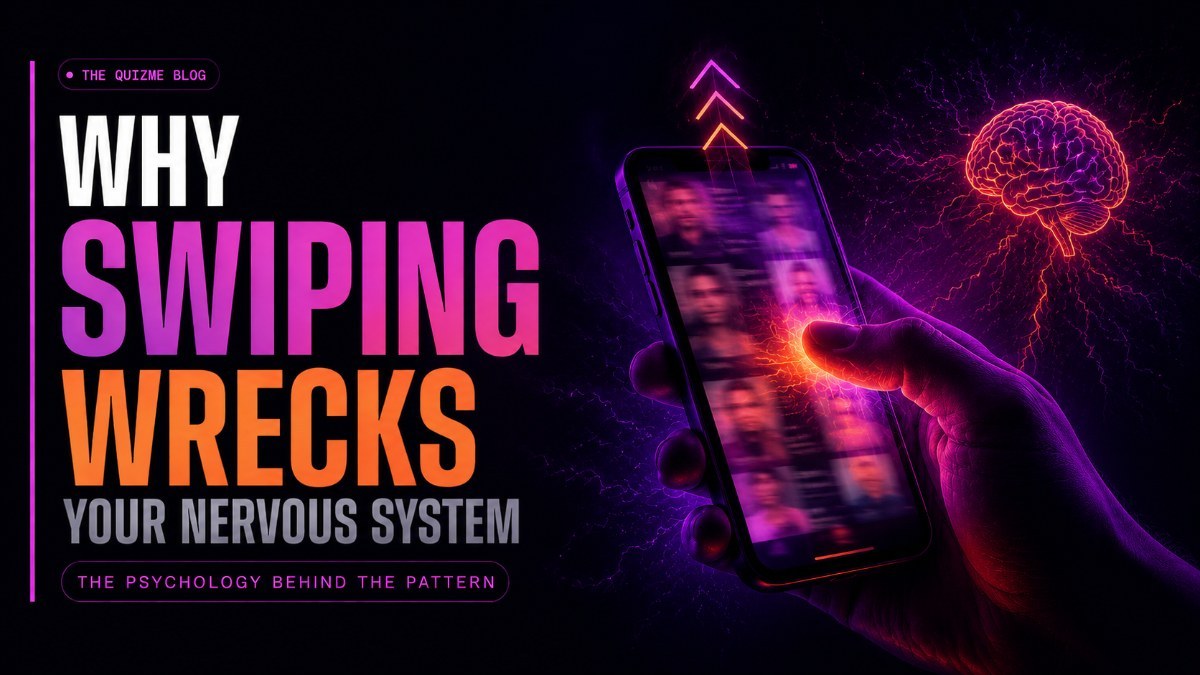
This is the particular cruelty of app-based dating for people with anxious attachment patterns: the format creates maximum ambiguity while providing just enough intermittent positive reinforcement to keep the loop going. That’s not a metaphor. Variable reward schedules, the same mechanism that makes slot machines compelling, are structurally embedded in swipe-based interfaces. Your attachment system was not designed to handle this.
The Three Attachment Patterns in Modern Dating
Hazan and Shaver’s three patterns look very different when you zoom in on what they actually produce as behavior in the app era. The secure pattern comes with comfort in both intimacy and independence. Secure daters send the message, don’t overthink the wait, don’t read the absence of an immediate reply as rejection, and feel genuinely okay about ending things that aren’t working. They’re underrepresented in dating app horror stories, partly because they tend to spend less time on the apps to begin with.
The anxious attachment pattern looks like hypervigilance to responsiveness cues: noticing when someone’s profile was last active, rereading conversations for hidden meaning, feeling the urge to re-engage quickly after silence, and interpreting ambiguity as evidence of fading interest. Hazan and Shaver found that people with this pattern tend to worry consistently about whether their partner truly cares, and that worry manifests in texting patterns within hours on a dating app timeline. The compressed courtship window makes everything feel more urgent, which turns up the volume on an already loud internal alarm system.
The avoidant attachment pattern looks calm from the outside, and that’s partly the point. Avoidant daters are genuinely uncomfortable with closeness, not because they don’t want connection but because closeness, historically, has felt unsafe or unreliable. On apps, this pattern shows up as keeping conversations surface-level, going quiet when things start to feel real, finding reasons why a promising match is actually not quite right, or just…, unmatching without explanation. The distance feels like self-sufficiency. Often it’s protection.
If you want to read more about how these patterns play out in real relationships, the attachment style guide on this site breaks it down in detail worth bookmarking.
Why Swipe Culture Rewards Avoidant Traits
There’s a particular irony buried in the architecture of swipe-based apps, which is that the traits most associated with successful navigation of those apps overlap significantly with traits that make long-term relationships harder. Dark triad traits, specifically psychopathy, narcissism, and Machiavellianism, have been studied extensively in relationship contexts. The research is consistent: people who score higher on dark triad traits gravitate toward shorter-term relationship structures, including one-night stands, hook-ups, and friends-with-benefits arrangements. They’re more willing to terminate relationships and report lower relationship satisfaction overall.
The dark triad also correlates with impulsivity and sensation-seeking, which maps neatly onto the swipe-based format’s constant novelty. An interface built around rapid assessment of physical attractiveness and instant connection with someone new is a comfortable habitat for someone who finds depth uncomfortable. It’s not that apps created these traits. It’s that the UX inadvertently selects for them, reducing friction for casual connection while creating structural barriers to the kind of slow, sustained attention that anxious daters need to feel secure, and that avoidant daters tend to feel suffocated by.
The result is a dating pool where people whose patterns make committed relationships difficult are also the people who are most at ease with the format. That’s not anyone’s fault, but it is worth knowing.
Feeling called out? Take the Why You Keep Dating the Same Person quiz, it takes about 3 minutes.
The Anxious-Avoidant Trap: A Dating App Tragedy in Three Acts
Act one: anxious dater matches with someone who seems emotionally unavailable but is also confident, a little mysterious, and very attractive. The avoidant dater’s initial warmth feels exciting precisely because it’s not constant. Intermittent warmth, to an anxious attachment system, reads as high value. You want more of the thing that’s scarce.
Act two: the avoidant dater starts to feel the pull of real connection and instinctively creates distance. They reply slower. Their messages get shorter. The anxious dater’s system registers this as an alarm: proximity to the attachment figure is threatened. They move toward, with more messages, more effort, more trying. The avoidant interprets this pursuit as pressure and pulls back further. The anxious dater’s alarm gets louder. You see where this goes.
Act three: the anxious dater is now in full hypervigilance, checking for signs of life, interpreting every emoji as meaningful data, running worst-case scenarios. The avoidant dater, overwhelmed by what feels like intensity, exits. The anxious dater is left with the familiar combination of rejection and confusion, often concluding that the problem is them, specifically. It isn’t. This is a pattern mismatch that app design makes structurally more likely, not a verdict on your worth as a person. The anxious-avoidant dynamic is one of the most well-documented pulls in relationship psychology, and you’re not the first person it has eaten alive.
Spotting Your Own Pattern: What to Actually Notice
Hazan and Shaver’s framework is useful here not as a label to claim but as a lens to look through. The question isn’t “which attachment style am I”, in the way you’d identify your MBTI type. The question is: what does uncertainty about someone’s interest do to my behavior?
Experiment 1: Track What Ambiguity Costs You
For one week, notice what happens in your body when a conversation goes quiet. Not what you think about it. What you feel physically. A tight chest, a checking compulsion, a flat detachment, a sudden flood of reasons this person wasn’t right anyway. The physical response is often more honest than the story you tell yourself about it. Anxious patterns usually feel like urgency. Avoidant patterns often feel like relief dressed up as indifference.
Experiment 2: Count the Gap Between Impulse and Action
When you want to re-send a message, re-check a profile, or find a reason to reach out after silence, notice how long the impulse lasts before it becomes action. This gap is where your pattern lives. A very short gap, impulse followed immediately by action, points toward anxious hypervigilance. A pattern of never acting, of rationalizing away the impulse entirely, points toward avoidant suppression. Secure responses tend to involve sitting with the uncertainty for a comfortable amount of time and then making a reasonable choice.
Experiment 3: Ask What You’re Actually Afraid Of
Beneath the texting behavior, the checking, the ghosting, the hot-and-cold cycling, there’s usually a specific fear that’s driving. For anxious patterns, it’s most often abandonment: if I don’t do something, they’ll leave and that will confirm I’m unlovable. For avoidant patterns, it’s often engulfment: if I let this get real, I’ll lose myself or get hurt in a way I can’t manage. Naming the fear doesn’t dissolve it, but it does interrupt the automaticity. You can’t work with a pattern you can’t see. This connects directly to what the attachment style guide identifies as the first step in disrupting insecure patterns.
Experiment 4: Notice Who You Feel Comfortable With
Anxious daters often feel most comfortable with partners who are slightly unavailable, not because they enjoy suffering but because that dynamic is familiar and familiarity registers as safety to the nervous system. Avoidant daters often feel most comfortable with partners who don’t ask for much, until that starts to feel boring or hollow. Pay attention to who you lose interest in quickly versus who keeps you hooked. The pattern of your attraction is data about your attachment system, not a coincidence about your luck.
The Common Pitfall and How to Get Past It
The biggest trap in applying attachment theory to your dating life is using it as a fixed identity instead of a flexible description. “I’m anxiously attached”, becomes a reason not to examine individual choices. “They’re avoidant”, becomes a reason to dismiss someone entirely rather than notice the specific dynamic you’re co-creating. The framework explains patterns. It doesn’t excuse them, and it definitely doesn’t determine your future.
The other pitfall is diagnosis-as-entertainment. There’s a version of this knowledge that feels good to consume, that lets you explain your exes and your situationships using tidy labels, without actually changing anything about how you show up. Attachment patterns are changeable. Research on what’s called “earned security”, suggests that people can develop more secure relational patterns through consistent positive relationship experiences, including friendships, therapy, and intentional reflection, over time. The label is a starting point, not a ceiling.
If you want to understand the related dynamics between how you present yourself and what you’re actually drawn to, the piece on why you can’t stop taking personality quizzes gets into the Barnum effect in a way that’s relevant here too.
What Self-Knowledge Is Actually For
Understanding your attachment pattern isn’t about finally having a good explanation for why your situationships fail. It’s about getting enough distance from the automatic response to choose a different one.
Bowlby’s Internal Working Model is a cognitive template, which means it can be updated. Not easily, and not quickly, but the template is not permanent. What changes it is repeated experience: of relationships where closeness is safe, of moments where you stayed with the discomfort instead of acting on it, of choosing transparency over the old defensive move. That’s slow work. But it’s the actual work, and understanding the framework is what makes it possible to do intentionally rather than accidentally.
Modern dating psychology is not really about apps. The apps are just the most recent environment in which very old attachment dynamics play out. The proximity-seeking, the fear of abandonment, the discomfort with closeness, these emerged in infancy and they’re not going anywhere because you updated your profile photos. What changes is your awareness of them, and what you do with that awareness in the moment when the impulse fires and you have a choice about what happens next.
You’re not bad at dating. You’re running a very old program on very new software. The first step is knowing which program it is.
Where to Start
If you’re reading this and feeling like you finally have language for something you’ve been living for years, the next move is specific. Take the attachment and dating quiz here, which is built around the behavioral patterns Hazan and Shaver identified and takes about three minutes. It won’t diagnose you. It will give you a clearer picture of which patterns tend to run your dating behavior, which is more useful than a label anyway.
From there, the anxious and avoidant explainer goes deep on the specific dynamic between those two patterns and why it’s so magnetic and so painful at the same time. And if you want to zoom out and think about how personality frameworks in general shape the way you see yourself in relationships, the piece on why quiz results are more accurate than you think is worth reading alongside this one.
The goal isn’t to turn yourself into a secure attacher overnight or to find someone who matches your attachment pattern on paper. The goal is to know yourself well enough that the automatic response has a little more distance before it becomes action. That gap, between impulse and choice, is where change actually happens.