
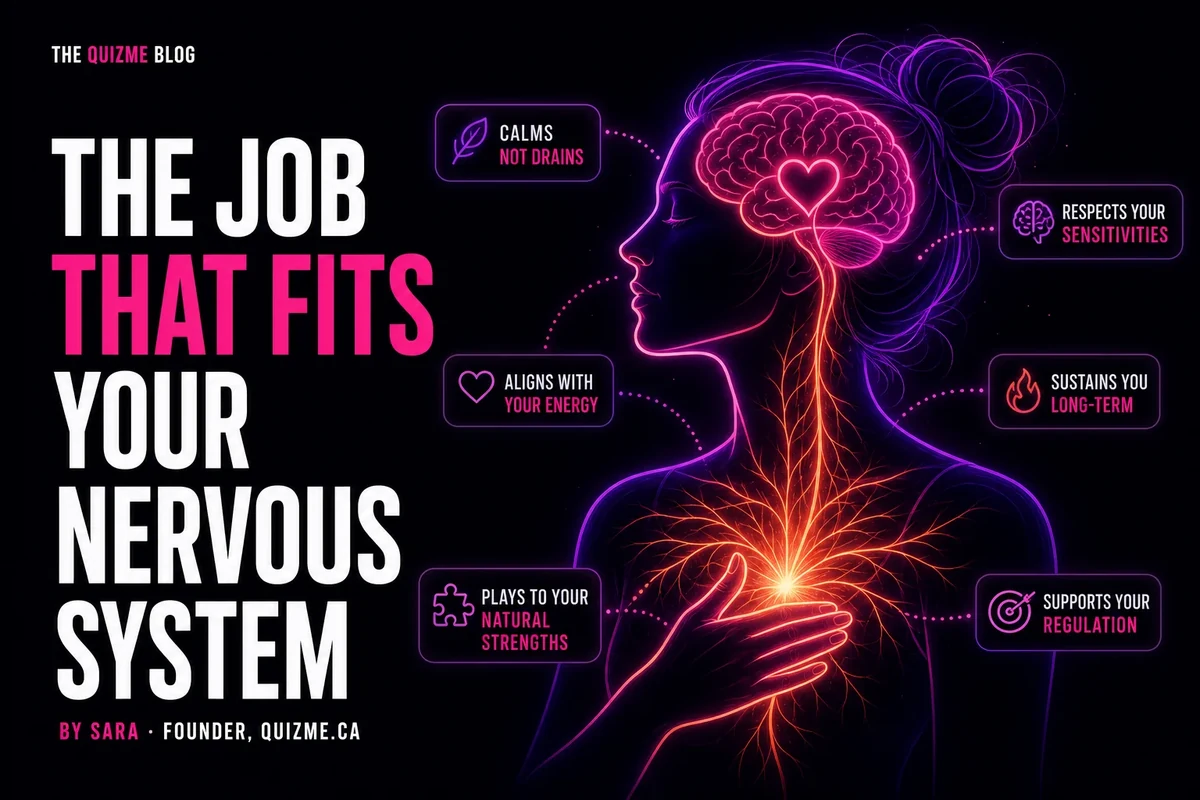
You’ve picked the right job on paper before. Good title, decent pay, a manager who seemed reasonable in the interview. And then six months in, you were exhausted in a way that had nothing to do with the workload. The tasks were fine. The actual job was grinding you down. What nobody told you is that career fit isn’t just about skills and ambition. A significant part of it is physiological: whether your nervous system can regulate itself in the environment where you spend most of your waking hours. Getting that wrong doesn’t produce mild discomfort. It produces the kind of bone-deep depletion that makes Sunday evenings feel like a countdown to punishment.
Why Personality Frameworks Miss the Point on Career Fit
Question 1 (Easy): What does the Big Five personality model measure? Most career quizzes sort you by strength or type. You get a result that says something like “you’re an analytical thinker who thrives in structured environments” and you’re supposed to use that to pick an industry. The Big Five model, which researchers consider far more reliable than the MBTI, tells you something real about your trait profile. High Conscientiousness predicts job performance across almost every role. High Openness to Experience correlates with creative persistence. These are genuinely useful signals about what you’ll be good at.
Question 2 (Hard): According to the article, which specific Big Five trait is most commonly overlooked when assessing career fit, and what physiological mechanism does it relate to? What they don’t tell you is what your nervous system can tolerate. And tolerance is where careers actually break down. You can be a high-Conscientiousness person who is also deeply sensitive to sensory input, which means you’ll do the work brilliantly as long as nobody puts you in an open-plan office where you’re managing fluorescent lights, twenty overlapping conversations, and a colleague who microwaves fish three days a week. The skill set is there. The environment eats it alive. If you’ve ever found the work personality test landscape frustrating, this is probably why: personality frameworks describe what you do well, but rarely describe the conditions under which you can actually do it.
The gap between those two things is nervous system fit, and it’s the career variable almost nobody is measuring explicitly.
What “Nervous System Fit” Actually Means
Your nervous system is constantly doing one job: deciding how safe or threatened the current environment is, and calibrating your body accordingly. When it detects threat, whether physical or social or sensory, it shifts you into a stress response. Heart rate climbs. Attention narrows. The brain’s threat-detection circuitry starts outcompeting the prefrontal cortex, which is the part responsible for complex thinking, creativity, and emotional nuance. You become technically functional but cognitively narrowed. Research on the autonomic nervous system confirms this: stress disrupts prefrontal cortex functioning through converging top-down and bottom-up mechanisms, making adaptive, flexible thinking progressively harder the longer the threat signal runs.
Question 3 (Easy): What is one example given in the article of something a nervous system might perceive as a threat in a work context? The word “threat” sounds dramatic for a work context, but physiologically your nervous system doesn’t distinguish between a predator and an open-plan office where your name might be called at any moment, or a Slack notification arriving at 11 PM, or the ambient roar of a busy floor. It responds to what it perceives as demands exceeding its capacity to regulate. A systematic review on sensory processing and occupational performance found that altered sensory processing can cause difficulties in sensory modulation, integration, and discrimination, all of which negatively affect occupational performance, functional participation, well-being, and quality of life.
This isn’t a weakness. It’s a trait distribution. Some nervous systems are calibrated to process a lot of input and find that stimulating. Others process deeply and find the same input overwhelming. Both are normal. Both are documented. What isn’t normal is spending forty hours a week in an environment your nervous system reads as actively hostile and calling the resulting depletion a motivation problem.
Question 4 (Hard): What specific cognitive tasks were found to be impaired by high-intensity urban noise exposure, according to the study cited in the article? The place this shows up most clearly is in the research on noise and cognitive performance. A study examining acute exposure to high-intensity urban noise found significant elevation of heart rate and stress perception in participants exposed to loud acoustic environments, with stress perception showing a strong relationship with the noise condition itself. High noise didn’t just feel bad. It measurably impaired the kind of risk-based and intertemporal decision-making that most knowledge work requires.1 Multiply that across every day in an environment that never fully quiets, and you start to understand why some people genuinely cannot think clearly in certain offices, regardless of how hard they try.
The Sensory Sensitivity Spectrum: You’re Probably Not Where You Think
Question 5 (Easy): Who is the psychologist most associated with research on highly sensitive persons? Sensory processing sensitivity exists on a spectrum. Psychologist Elaine Aron’s research identified what she called the highly sensitive person: someone whose nervous system processes environmental and emotional stimuli more deeply than average, noticing subtleties others miss, being moved more easily by beauty or sadness, and also more easily overwhelmed by overstimulation. Aron’s estimates suggest this trait characterizes a meaningful portion of the population, though not a majority, making it common enough to be pervasive but rare enough that most workplaces aren’t designed around it.
But sensitivity isn’t a binary. The Big Five trait of Neuroticism, which measures emotional reactivity and the tendency to experience negative emotions, intersects significantly with how much environmental stress a person can absorb before their performance suffers. High Neuroticism doesn’t mean you’re anxious all the time. It means your nervous system registers disruptions more intensely and takes longer to return to baseline. In a calm, predictable environment with adequate autonomy, a high-Neuroticism person can be a meticulous, emotionally intelligent, deeply engaged colleague. In a chaotic, high-interruption environment, the same person burns out at a rate that looks baffling to their managers.
Research on environmental sensitivity profiles among professionals found distinct patterns: some individuals are high in sensory sensitivity but lower in emotional reactivity, some show the reverse, and some score high across both dimensions. These profiles don’t predict whether someone is good at their job. They predict which type of job environment will allow them to stay regulated enough to be good at it. That’s a fundamentally different question from what most career assessments ask. One thing this framing can miss, though: nervous system fit is not fixed. Therapeutic interventions, autonomic regulation practices, and changes in life circumstances can shift your window of tolerance over time. This isn’t destiny. It’s a starting point.
Four Nervous System Patterns and the Work Environments They Need
1. The High-Stimulation Seeker
You get your best thinking done in motion. A quiet room feels like a sensory deprivation tank after an hour. You like having multiple threads running, you’re energized by conversation, and the thought of a solitary research role makes you feel vaguely panicked. This maps broadly onto high Extraversion in the Big Five, but the nervous system lens adds something the trait label misses: you’re not just social, you’re regulated by stimulation. The baseline arousal your nervous system prefers sits higher than average, and environments that don’t feed it make you restless and foggy.
Environments that fit: sales, event coordination, journalism, emergency medicine, teaching, client-facing consulting. The key ingredient isn’t busyness for its own sake. It’s variety and social contact on a relatively unpredictable schedule. High-stimulation seekers often struggle in roles that require sustained, solitary deep work, not because they can’t concentrate, but because the nervous system gets bored in a way that genuinely degrades performance. One caveat: stimulation-seeking doesn’t mean chaos tolerance. High-stimulation seekers who also score high on structure (high Conscientiousness) may need high input but low ambiguity: active environments with clear rules.
- Look for roles with frequent human contact and varied daily demands.
- Identify whether your stimulation need is social, sensory, or intellectual, since these lead to different role fits.
2. The Deep-Focus System
You do your best work in long, uninterrupted blocks. Meetings feel like someone keeps pulling you out of a warm bath. You’re probably efficient in a way that confuses people who mistake busyness for productivity, because you can accomplish in two focused hours what takes others an entire fragmented day. This pattern correlates with lower Extraversion and often higher Openness to Experience, but the nervous system angle is that your system reaches optimal performance at a lower baseline arousal. Noise, interruption, and social obligation don’t just distract you: they actively consume the regulatory resources you need for deep thinking.
Environments that fit: software development, research, writing, data analysis, architecture, accounting, any role where the core output is made by a single person over sustained time. The breakdown point for this pattern is often the modern open-plan office, where the assumption is that proximity produces collaboration. For deep-focus systems, proximity to constant noise and micro-interruption produces something closer to chronic mild stress, and research on sensory processing confirms that unmanaged sensory load affects occupational performance at a systems level, not just a mood level.
- Advocate explicitly for protected deep-work blocks, even in roles that nominally require collaboration.
- Evaluate office environment as seriously as you evaluate job description during the hiring process.
- Remote or hybrid options aren’t a perk for this pattern: they’re often the difference between thriving and surviving.
3. The High-Empathy Processor
You read rooms with unsettling accuracy. You know when a client is unhappy before they say anything. Conflict, even conflict that doesn’t involve you, sits in your body for hours. You often end the day more depleted by the emotional weather of the room than by the actual work you did. This pattern shows up in people who score high on Agreeableness and Neuroticism together, often combined with sensory sensitivity, and it creates a specific occupational hazard: roles that look like a good fit because they involve helping people can become a nervous system tax if they involve high emotional volatility, secondhand distress, or relationship conflict without recovery time.
Environments that fit: therapy and counseling (with strong boundaries and supervision), user research, teaching in contained environments, social work in settings with adequate support structures. The places this pattern gets misread: high-empathy processors often excel in client-facing roles and get promoted into management, which involves absorbing distress from an entire team rather than a few individuals. The promotion looks like recognition. The nervous system registers it as a significant increase in unmanaged load. Research on burnout by Christina Maslach and her colleagues identified emotional exhaustion as the core of occupational burnout, directly linked to demands and inversely linked to available resources. High-empathy processors hit emotional exhaustion faster in under-resourced environments, full stop.
4. The Variable-Threshold System
You don’t fit a clean pattern. Some days the office is fine, other days the same environment feels unbearable. You’ve wondered if you’re just inconsistent or difficult. What you might actually be dealing with is a nervous system whose window of tolerance shifts based on sleep, hormonal cycles, accumulated stress load, and background life events. This isn’t pathology. It’s the experience of having a system that’s more context-sensitive than average, which maps onto what researchers studying environmental sensitivity profiles call the “high reactive” pattern: greater responsiveness to both negative and positive environments, meaning you’re more affected by bad conditions but also more lifted by good ones.
Environments that fit: roles with genuine flexibility in when and how the work gets done, cultures where output is measured rather than presence, teams where explaining a bad day doesn’t require a medical diagnosis. The problem isn’t the variable-threshold system. The problem is that most workplaces are designed for consistency and penalize the fluctuation that comes with high environmental reactivity.
- Track your regulation patterns over a few weeks to see whether the variability is random or linked to specific triggers.
- Look for roles with asynchronous communication norms, where you’re not expected to perform regulation in real time all day.
Feeling called out? Take the Work Personality quiz, it takes about 3 minutes.
The Common Pitfall: Treating Nervous System Mismatch as a Character Flaw
The story most people tell themselves when their environment doesn’t fit goes something like this: I’m not resilient enough. I’m too sensitive. I need to toughen up. Other people manage this environment just fine, so the problem must be me. This framing is so pervasive that it’s worth naming directly: it is almost certainly wrong, and it causes real harm.
Nervous system sensitivity is not a deficit. Research on the highly sensitive trait consistently finds that it’s associated with deeper cognitive processing, stronger empathic accuracy, and heightened responsiveness to positive environments, not just negative ones. The issue is not the trait. The issue is fit. And the research on burnout is clear that fit is a structural problem. Maslach and colleagues found that work environment factors including high demands with limited control, lack of autonomy, and inadequate reward relative to effort all predict burnout outcomes at a group level. The nervous system is experiencing the downstream effects of a structural mismatch, not demonstrating a personal weakness.
The trap is that sensitive nervous systems are often very good at masking. You can appear to perform fine in a poor-fit environment for months or years, particularly if you’re high in Conscientiousness. What’s actually happening underneath is something researchers describe as sustained regulatory expenditure: the ongoing cost of appearing regulated when you’re not. There’s a price tag attached to that mask, and eventually the bill arrives. Often it arrives as burnout, in its full Maslach-defined form: emotional exhaustion, cynicism, and reduced sense of personal efficacy. And because the collapse seems sudden, people attribute it to the final straw rather than to the years of invisible depletion that preceded it.
The nervous system doesn’t grade you on effort. It doesn’t care how badly you want the job to work. It keeps an honest ledger of input versus capacity, and eventually that ledger comes due.
If you’ve noticed that you end every workday genuinely drained in a way that doesn’t resolve with normal rest, that’s not a productivity problem. That’s the ledger talking.
What Self-Knowledge Is Actually For
There’s a version of personality and nervous system knowledge that becomes another way to limit yourself. You decide you’re a “deep-focus system” and use that label to avoid any role with collaboration. You decide you’re too sensitive for leadership and opt yourself out of opportunities before anyone else gets the chance to. The nervous system lens isn’t a ceiling. It’s a diagnostic tool.
The goal isn’t to only ever work in perfectly calibrated environments. Sometimes perfect fit isn’t available, and adaptability is genuinely worth building. The goal is to stop misdiagnosing environment mismatch as personal failure, and to start making deliberate choices about which tradeoffs you’re willing to accept and which ones are quietly breaking you. Knowing your nervous system doesn’t exempt you from hard work. It exempts you from the particularly pointless kind of hard work that involves spending your entire regulatory budget just getting through the sensory and social conditions of your day before you’ve done a single thing that actually required effort.
It also changes how you negotiate. When you understand that your performance drops not because you lack skills but because chronic sensory overload is competing with your prefrontal cortex, you can ask for a quieter workspace, protected focus time, or a shift to asynchronous communication as a concrete performance strategy, not as a special accommodation for a personal quirk. That reframe changes the conversation entirely. The grind mentality insists that more effort in any environment is always the answer. The nervous system disagrees, and it has the physiological data to back that up.
Self-knowledge isn’t self-indulgence. It’s the most efficient operating system you have access to, and most people never read the manual.
Where to Start: Reading Your Own Regulation Signals
The most useful thing you can do right now is run a simple audit on your current work environment, not on your performance or your output, but on your regulation. At the end of each workday for two weeks, note the following: your energy level on a scale from depleted to full, the primary source of depletion if it’s present (sensory load, social demand, emotional labor, cognitive fragmentation, unpredictability), and anything in the environment that shifted you toward feeling calmer and more capable. Two weeks of that data will tell you more about your nervous system’s occupational needs than any single quiz result.
From there, compare your depletion sources against the role demands that aren’t likely to change. If your primary depletion is sensory load and you’re in an open-plan office with no remote option and no budget for noise-canceling equipment, that’s structural information, not temporary discomfort. If your depletion is primarily social and you’re in a role that requires eight hours of client interaction daily, the gap between what your system needs and what the role demands is something you can either address or decide to stop ignoring.
If you want a more structured starting point, exploring the career quizzes on the platform can give you a useful baseline. The work personality framework there covers the Big Five dimensions most predictive of job performance and environment fit, which pairs well with the nervous system lens laid out here. Personality tells you what you do well. The nervous system question tells you where you can sustain doing it. You need both answers to actually make a good decision about where to spend the next several years of your working life.
The resume gets you in the room. Your nervous system decides whether you can stay.
1 “Urban noise-induced stress and decision-making: effects of high-intensity acoustic exposure on risk-based and intertemporal choices.” Quasi-experimental study examining acute exposure to high-intensity urban noise (85, 95 dB) in healthy adults, assessing autonomic stress response and cognitive performance on risk-based and intertemporal decision tasks. Published in peer-reviewed form via Frontiers in Psychology and related journals covering environmental stressors and cognition.