
“`html
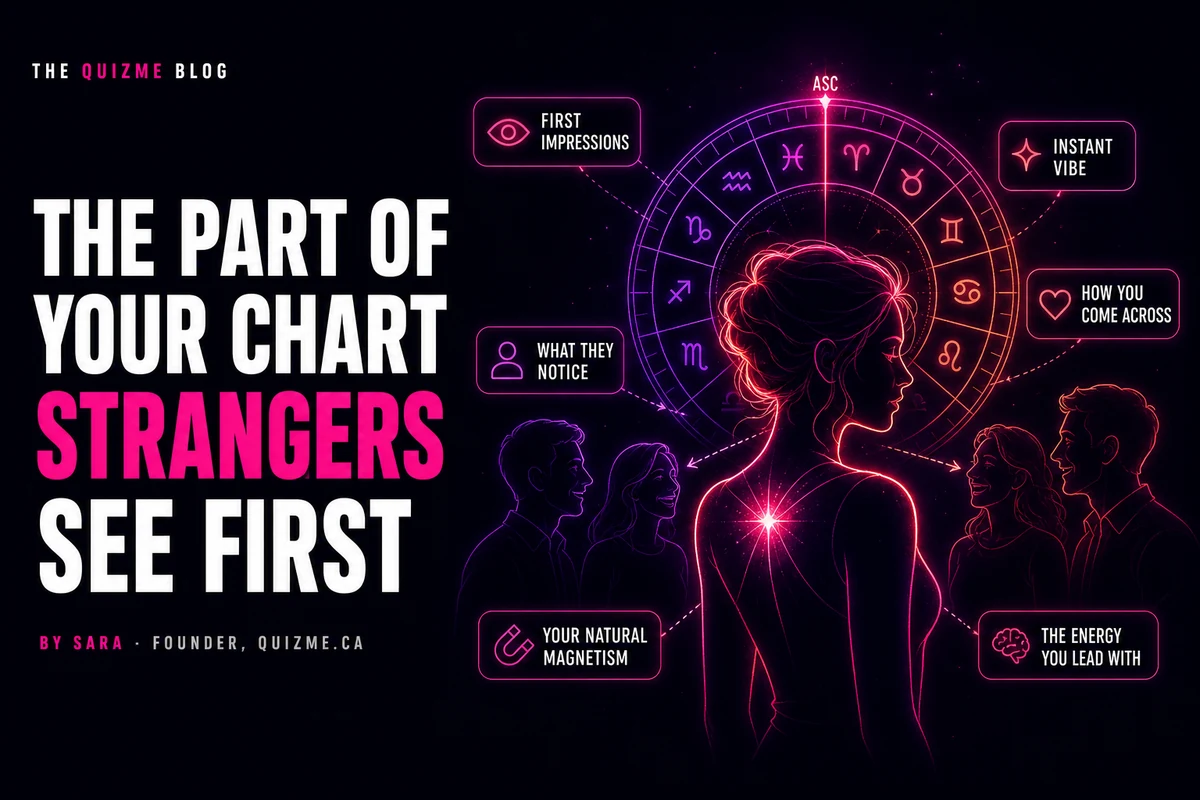
You walk into a party. Before you’ve introduced yourself, before anyone knows your name or your job or your complicated history, people have already formed an opinion. Not a complete one, but a working theory. Something about your energy, your posture, the way you occupy space. In astrology, that’s your rising sign talking. In psychology, that’s something equally interesting happening, and the two explanations are more compatible than either side usually admits.
Your rising sign, also called the ascendant, is the zodiac sign that was on the eastern horizon at the exact moment you were born. Unlike your sun sign, which is determined by your birthday and takes about a month to change, your ascendant shifts every two hours. It’s the most time-sensitive point in your chart, which is why astrologers need your birth time to calculate it, and why many people don’t know theirs. It’s also, in traditional astrology, the most important point in the entire chart. Not the sun. The ascendant.
The reason it matters so much, according to astrological tradition, is that the rising sign governs the first impression you make. It’s the mask you wear, the social self you lead with, the energy others feel from you before they know anything else. If that sounds suspiciously like something psychology has also spent decades studying, it’s because it is. The overlap is worth unpacking, not to prove astrology right, and not to dismiss it, but because understanding what a “social self” actually is makes both systems more useful. If you want to go deeper on astrology and what the research actually says about it, that’s a good place to orient yourself first.
What the Rising Sign Is Actually Claiming
Ask an astrologer what your rising sign means and they’ll usually describe it as your “outer self,” the personality you show to the world rather than the one you carry privately. A Scorpio sun with a Sagittarius rising will come across as more open and adventurous than their inner intensity might suggest. A Cancer sun with a Capricorn rising will seem cool and self-contained at first meeting, even if they’re melting internally. The sun is who you are, the rising is how you arrive.
This is actually a more sophisticated claim than the one most pop astrology makes. The rising sign doesn’t promise that your “true self” is hidden behind a facade. It suggests that different contexts call out different parts of us, and that the first-impression version is a real, coherent layer rather than a performance. That’s a meaningful distinction. And it’s one that psychology backs up, though not in the way astrologers usually mean it.
The word “personality” itself comes from the Latin persona, meaning mask. Not in the deceptive sense, but in the theatrical one: the face through which sound passes, the character you play in the social drama. Personality psychology has grappled with this from its earliest days. Gordon Allport, writing in 1937, was already drawing the line between traits that are stable across situations and those that emerge in specific contexts. The idea that you have a “social face” that’s partly distinct from your interior life is not controversial in psychology. It’s basically foundational.
What Psychology Actually Knows About First Impressions
Here’s where things get genuinely interesting. Social psychology has spent considerable effort studying exactly what happens in the first few seconds of meeting someone, and the findings are both more impressive and more humbling than most people expect.
Psychologist Nalini Ambady, working with Robert Rosenthal in the 1990s, pioneered research on what she called “thin slicing”: the ability to make accurate personality judgments from very brief exposures to behavior. In a series of studies, Ambady found that people could form surprisingly accurate impressions of a stranger’s extraversion and agreeableness from just a few seconds of observation, sometimes a silent video clip. These aren’t complete portraits, but they’re better than chance, and they hold up against longer observations. The snap judgment you make when someone walks into a room is not pure noise.
What thin-slicing research tells us is that people do project real personality information through their behavior, and that others pick it up quickly. Extraversion, in particular, is one of the most visible Big Five traits: it leaks through posture, eye contact, speech speed, and physical energy in ways that strangers read almost instantly. Agreeableness is next most legible. Conscientiousness, openness, and neuroticism take longer to read and require more information.
This is the psychological backbone the rising sign concept has always been reaching for, even if the mechanism is different. The astrology claim is that your ascendant sign shapes your social presentation. The psychology finding is that your social presentation is real and readable, and that certain traits dominate it. Where the frameworks diverge is on why: astrology credits the position of the horizon at birth, psychology points to genetics, early environment, and habit. But both are describing the same phenomenon: you lead with a recognizable energy, and people pick it up.
Where the mapping breaks down is important to name. Not everyone’s rising sign description matches their observed social presentation. A person with a “warm, gregarious” Leo rising can be socially anxious and withdrawn if neuroticism is also high, because anxiety has a way of overriding the default extraversion script. The ascendant is a tendency, not a guarantee, and treating it as a fixed behavioral blueprint is where the system oversimplifies.
The Persona You Built and the One You Were Born With
Here’s something astrology handles well and psychology sometimes underplays: the rising sign is not just about how you naturally present. It’s about the role you were handed at birth and learned to inhabit. You were born into a family, a culture, a set of early relationships, and those contexts shaped which parts of yourself you learned to lead with. The social self is real, but it’s also constructed.
Carl Jung, whose work eventually gave us the MBTI (with significant modifications by Isabel Briggs Myers and Katharine Cook Briggs), had a concept he called the persona: the social face we develop to navigate the external world. The persona isn’t false. It’s the part of yourself that learned to perform in the specific theater of your life. The problem Jung identified wasn’t having a persona, but identifying with it so completely that you lose track of what’s underneath. When your rising sign is the only thing you show the world, your sun sign and moon sign, the interior dimensions, start to atrophy from neglect.
This is where the three-part model in astrology, sun, moon, rising, actually maps reasonably well onto a psychological framework. The sun corresponds loosely to core identity: the stable trait pattern that persists across situations. The moon corresponds to emotional reactivity and interior states: what you feel privately, what you need but don’t always show. The rising corresponds to the social interface: the presentation layer that other people read first. None of these is more “real” than the others. They’re just different registers of the same person.
The gap between your sun and your rising is worth sitting with. If there’s a big difference between how people describe you on first meeting and how you’d describe yourself, that gap is information. It might mean you’re more guarded than you realize. It might mean you’ve built a social persona that’s doing a lot of protective work. It might just mean your chart has an interesting internal contrast. Understanding the gap is more useful than resolving it.
Feeling called out? Take the Your Chart Meets Your Personality quiz, it takes about 3 minutes.
Four Experiments Worth Running on Your Rising Sign
1. Ask Someone Who Met You Recently How They’d Describe You
Not a close friend. Someone who has known you for two or three months. People who know you well have already updated their first impression with all the complexity they’ve accumulated, newer acquaintances are still operating on the initial read. Ask them: “What’s the first word that comes to mind when you think of me?” The answer might surprise you. Compare it to your rising sign description and your sun sign description. Notice which one lands closer. You’re not trying to confirm the system, you’re gathering data about the gap between your interior self-concept and your social projection.
2. Notice When Your Rising Sign Description Feels Like a Costume
Some people wear their rising sign comfortably, it’s an accurate description of how they move through the world in public contexts. Others find it slightly foreign, like a personality they were assigned rather than one they chose. If reading your rising sign description produces mild discomfort or a feeling of “that’s not really me,” pay attention to that. In psychological terms, you may have a significant gap between your public self and your self-concept. That gap is not a problem to fix, it’s useful information about where you code-switch and what it costs you. Related: the personality trait hiding your real self covers exactly this terrain.
3. Map Your Rising Sign to the Big Five
This is an imperfect but illuminating exercise. Each rising sign, in broad terms, emphasizes certain traits. Aries rising reads as high extraversion and assertiveness. Libra rising reads as high agreeableness and social polish. Scorpio rising reads as low agreeableness in the surface sense, with high intensity and perceptiveness. Virgo rising reads as conscientiousness made visible. You don’t have to believe the astrology to use the question: which Big Five dimensions do other people perceive in me immediately? Extraversion and agreeableness are the most first-impression-visible, so they’re worth interrogating specifically. If your rising sign emphasizes extraversion but you score low on it in self-report, that gap is worth noticing.
4. Trace the Origin Story of Your Social Self
The most psychologically useful thing you can do with your rising sign is treat it as a question rather than an answer. Specifically: where did this version of you come from? Your first-impression self was developed over years, shaped by what was rewarded in your family of origin, what kept you safe in early social situations, what role you were implicitly assigned. The Capricorn rising who comes across as competent and collected from day one may have learned that emotional display was unsafe. The Gemini rising who leads with wit and social ease may have discovered early that humor was the fastest path to belonging. The pattern is real. The origin is worth knowing. For more on how early patterns shape adult behavior, the piece on why you keep dating the same person covers adjacent territory.
The Pitfall: Using Your Rising Sign to Explain Away the Gap
Here’s where the rising sign concept can become a comfortable trap. If people consistently perceive you differently from how you see yourself, the astrology framework offers an easy explanation: “That’s just my Aquarius rising. That’s the mask, not the real me.” And sometimes that’s accurate. But sometimes the gap between perceived self and self-concept is telling you something else, something worth sitting with rather than resolving with a birth chart.
In psychology, the discrepancy between how we see ourselves and how others see us is one of the more reliably uncomfortable areas of self-knowledge. Research on confirmation bias shows we tend to selectively remember the feedback that confirms our existing self-concept and discount feedback that challenges it. If everyone at the party thought you were standoffish, and you spent the evening feeling warm and open internally, it’s possible that a) your interiority didn’t project outward, b) something in your body language communicated differently than your internal state, or c) you were being read through others’ biases. All three are worth investigating. “That’s just my rising sign” can do the work of investigation if you let it prompt questions, but it fails you if you use it to close the inquiry.
The gap between who you are and how you arrive is not a flaw in the system. It’s the whole interesting question.
Confirmation bias also shapes how we interact with our own chart readings. Psychologist Paul Meehl named the Barnum effect in 1956, after P.T. Barnum, the showman famous for having something for everyone. The effect describes our tendency to rate vague, generally applicable personality descriptions as highly accurate, particularly when we trust the source providing the feedback. Astrology believers, in particular, have been shown to rate Barnum-style profiles as more personally accurate than skeptics do, even when the profile is identical for everyone.1 So when your rising sign description feels exactly right, hold that feeling lightly: it may be precision, or it may be the Barnum effect doing its quiet work. For a deeper look at that dynamic, the piece on why your birth chart feels so right goes into the mechanism directly.
What Your Vibe Is Actually Made Of
The most honest synthesis between the astrology of the rising sign and the psychology of first impressions is this: your social self is real, it’s legible to others, and it’s worth understanding. Whether the pattern has anything to do with the zodiac sign on the eastern horizon at the moment of your birth is a separate question, one that empirical research has not been kind to. But the underlying insight that you lead with a specific energy, that this energy can diverge from your interior life, and that understanding the gap tells you something important, that’s not mystical. It’s just good self-knowledge.
The word “vibe” is doing real work here, even though it sounds casual. What people read from you in the first few minutes of contact is a genuine signal. Thin-slicing research suggests it’s not random. The traits most legible in first impressions, extraversion and agreeableness most prominently, are exactly the traits most associated with rising sign descriptions across all twelve signs. Astrology organized these observations through one framework, personality psychology organized them through another. The observations themselves, that people project readable social energy and that others pick it up quickly and consistently, are solid.
The astrology framework gives the rising sign a specificity that the psychology framework doesn’t claim. Saying your Sagittarius rising explains your open, optimistic first impression is more precise and more satisfying than saying “high extraversion and agreeableness scores produce warm first impressions.” But specificity and accuracy are different things. And the Barnum effect reminds us that specificity often feels more accurate even when it isn’t measuring anything more precisely. For the broader comparison between these two systems and what they each get right, When Your Chart Meets the Science is worth reading alongside this one.
Both systems are saying: you arrive somewhere before you speak. Learning to see that arrival clearly, and to choose how you show up, is the actual work.
Where to Take This Next
If you don’t know your rising sign yet, you’ll need your exact birth time and place, not just your birthday. Most free chart calculators will give you your ascendant in about thirty seconds once you have those details. If you were born without a recorded birth time, some astrologers use a process called chart rectification to estimate it from life events, but it’s inexact. Many people with unknown birth times simply work with their sun and moon signs and accept the gap.
Once you know it, the more useful question isn’t “does this describe me?” The Barnum effect means it probably will, regardless of accuracy. The better question is: does this describe how other people experience me, particularly people who don’t know me well? That’s the test the rising sign is actually designed for. If the description matches your observed first impression but diverges significantly from your self-concept, you have found something genuinely worth exploring.
The personality map you actually live in is a good starting point if you want to understand where your self-concept comes from and how reliably it tracks your actual behavior. And if the gap between your public self and your private self is starting to feel less like an interesting contrast and more like a weight, the professional mask has a price tag covers the psychology of what it costs to maintain a persona over time.
Your rising sign is, at minimum, a useful prompt: what do people actually see when they look at you, and how much of that is intentional? The answer to that question belongs to you, not to any system. The chart just gives you a place to start asking.
Sources and further reading
1 Research summarized in the psychology of astrology literature found that astrological believers rated Barnum-style profiles as more personally accurate than skeptics did, even when profile content was held constant across subjects. The foundational demonstration was Bertram Forer’s 1949 classroom study,