
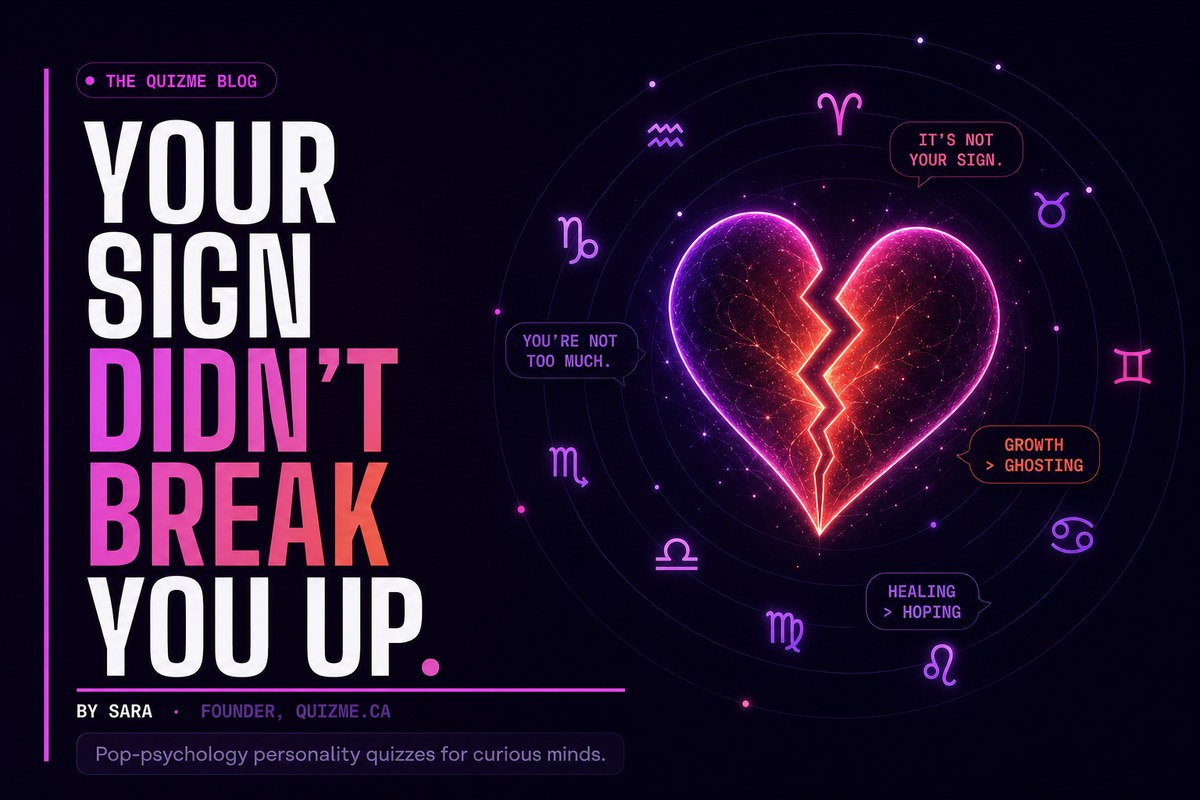
You’ve felt this: you find out someone’s sign and suddenly everything clicks. Of course they pulled away when things got serious, they’re an Aquarius. Of course you two couldn’t stop fighting, Scorpio-Leo is basically a dumpster fire with good chemistry. Of course it ended. The chart said so. And the thing is, it felt true. Not because the planets arranged themselves to destroy your situationship, but because zodiac compatibility does something genuinely useful: it gives you a language for relational patterns you already sensed but couldn’t name. The problem isn’t that astrology feels meaningful. The problem is that when we hand all that meaning to the stars, we stop looking at the actual mechanics underneath. And those mechanics, rooted in attachment theory and personality research, have a lot more to say about zodiac compatibility than any sun sign pairing chart.
Why Zodiac Compatibility Feels Like It’s Predicting Your Actual Relationship
Here’s the uncomfortable truth about why compatibility charts feel so accurate: they’re designed to be. Not in a conspiratorial way, just in a psychologically predictable one. The descriptions are broad enough that almost anyone can find themselves in them, and specific enough to feel targeted. This is sometimes called the Barnum effect, after the showman P.T. Barnum, and it’s the same reason horoscope readings feel eerily personal. When you read that Pisces is emotionally intense and Gemini is emotionally unavailable, you’re not getting a prediction. You’re getting a mirror that’s slightly curved to reflect everyone.
Philosopher of science Karl Popper identified astrology as a classic pseudoscience specifically because it cannot be falsified. When a Scorpio-Aries relationship works, it’s because “fire signs balance each other’s passion.” When it doesn’t work, it’s because “they’re both too dominant.” Any outcome can be retrofitted into the narrative, which means the framework can never actually be wrong. That’s not insight, that’s a very compelling story. As noted in the Wikipedia overview of astrology and science, astrology “provides the quintessential example of a pseudoscience since it has been tested repeatedly and failed all the tests.”
So why does it still feel like it’s working? Because you’re not remembering every time your Taurus partner was spontaneous and flexible. You’re remembering every time they dug their heels in and thinking: stubborn Taurus, classic. That’s confirmation bias doing exactly what it’s built to do: scanning for evidence that confirms what you already believe and quietly filing away everything that doesn’t fit. The astrology isn’t predicting your relationship. Your relationship is confirming the astrology, after the fact, every time.
The Attachment Style Behind Your “Sign Match”
Underneath the zodiac vocabulary, there’s a psychological architecture that actually does predict how people show up in relationships. Researchers Cindy Hazan and Phillip Shaver applied Bowlby’s attachment framework to adult romantic relationships and found that the way adults manage intimacy, independence, and conflict in love maps onto three core patterns: secure, anxious, and avoidant. These aren’t personality quirks. They’re strategies, developed early, for navigating closeness with people who matter to you.
Now look at how zodiac “compatibility” descriptions actually work. Water signs, Cancer, Scorpio, Pisces, are consistently described as emotionally intense, deeply feeling, prone to jealousy, needing reassurance, afraid of abandonment. That’s a fairly precise description of anxious attachment. Air signs, Gemini, Libra, Aquarius, are described as needing freedom, intellectualizing emotions, going cold when relationships feel too heavy. That’s avoidant attachment dressed up in astrological language. Earth signs lean toward the stable, reliable, sometimes rigid patterns associated with secure-adjacent or avoidant presentations, depending on the sign. Fire signs are described as passionate but conflict-prone, which maps onto what happens when two people with clashing regulation styles collide.
When people say “water and air signs don’t work,” they’re often noticing something real: the anxious-avoidant pairing is genuinely one of the hardest relational dynamics to sustain. The more one person needs closeness, the more the other distances. The more the other distances, the more the first escalates. It’s not written in the sky. It’s written in decades of attachment research. The planets aren’t the problem. The pattern is.
If you’ve ever been the one texting twice before they respond once, you might already know your side of this dynamic. The attachment style you didn’t know you had has a lot more to say about your relationship patterns than your sun sign does.
What Your “Incompatible” Pairing Actually Reveals
People in supposedly incompatible sign pairings make it work all the time. People in supposedly ideal pairings crash and burn spectacularly. If you’ve watched a “perfect” Libra-Gemini air sign couple dissolve over fundamental value differences, or a supposedly chaotic Scorpio-Aquarius pairing outlast everyone’s predictions, you’ve already observed the gap between chart compatibility and actual relationship viability.
What actually predicts whether two people can build something together? Conflict resolution style matters enormously. So does emotional regulation capacity: the ability to stay present in a difficult conversation without shutting down or escalating. So does the degree to which people share a framework for what relationships are for and what they require. None of these things correlate with birth date. Two people with mismatched attachment styles can build a stable relationship, but it requires something astrology doesn’t teach: intentional communication skills, willingness to see your own patterns clearly, and the capacity to tolerate discomfort without immediately blaming your partner’s sign.
The “incompatible” label can actually do damage here, because it offers a built-in exit before the harder work begins. If the chart says it won’t work, why bother examining how you each handle a fight? Why look at whether you’ve had this same dynamic with three different people across three different signs? The zodiac is a very comfortable place to put the responsibility for relational patterns that are actually internal, portable, and very much worth examining.
Feeling called out? Take the Attachment Style quiz, it takes about 3 minutes.
The Big Five Traits Hiding in Your Zodiac Description
Here’s where it gets interesting for personality nerds. The Big Five model, often called OCEAN for its five dimensions of Openness, Conscientiousness, Extraversion, Agreeableness, and Neuroticism, is one of the most empirically supported frameworks in personality psychology. And when you read zodiac compatibility breakdowns carefully, you start to see these traits in every description.
When people say “Capricorn-Scorpio is a power couple,” they’re often describing something real: high conscientiousness in one or both partners, combined with intensity and drive. Research on the Big Five consistently shows that conscientiousness is a strong predictor of relationship stability, partly because it predicts follow-through, reliability, and the ability to do the unsexy maintenance work that long-term relationships require. The bigfive_wikipedia source notes that conscientiousness “has consistently emerged as a stable predictor” across multiple outcome domains, and relationship research echoes this finding.
Agreeableness, the dimension covering warmth, cooperation, and willingness to prioritize others, also shows up in compatibility language. The “sweet, nurturing Cancer” is describing high agreeableness. The “cold, logical Virgo” might be describing someone lower on agreeableness paired with high conscientiousness. When two people describe their pairing as “we just work,” they’re often describing a complementary or matching profile on these dimensions, not a planetary alignment.
Neuroticism, which captures emotional reactivity and stress sensitivity, is probably hiding inside every “dramatic water sign” description you’ve ever read. High neuroticism isn’t a flaw, it’s a trait with real costs and real benefits. But when it’s in the room, it shapes the relational dynamic profoundly regardless of what month either person was born in. If you’ve ever tested your own profile, your chart meeting the science might reframe what you’ve always called your “Scorpio intensity.”
The Patterns Worth Sitting With
1. Map Your Conflict Style, Not Your Sign
The next time you have a fight with a partner, resist the urge to reach for a compatibility chart. Instead, notice what you do in the first ten minutes of a conflict. Do you escalate? Go quiet? Need immediate resolution? Leave the room? This is your conflict style, and it’s far more predictive of relationship health than sun sign alignment. Two people who both go silent and stonewall will have a different but equally difficult time than two people where one escalates and one withdraws. Recognizing the pattern is the first step to interrupting it.
2. Notice Who You’re Always Attracted To
If you’ve dated three “emotionally unavailable” people and they happened to be a Gemini, a Libra, and an Aquarius, it’s tempting to write off air signs. But what if they were a Scorpio, a Cancer, and a Capricorn? The sign changes. The dynamic doesn’t. That’s worth pausing on. Why you keep dating the same person in different bodies has a psychological explanation, and it starts with your own attachment history, not their birth month.
3. Test the Barnum Effect on Yourself
Find a detailed personality description for a sign that is supposedly your least compatible match. Read it slowly. Notice how many traits feel like you. Notice how many sound like someone you love. The specificity that makes zodiac descriptions feel true is actually their broadness: they’re written to resonate widely. This isn’t to say all astrology content is useless, it’s to calibrate how much diagnostic weight you’re putting on a framework that was never built for falsification.
4. Separate the Language from the Insight
You can use zodiac language as a starting point without treating it as an endpoint. If saying “I’m going into Scorpio mode” helps you communicate to a partner that you’re feeling possessive and scared, that’s useful shorthand. The problem is when the label replaces the conversation: “I can’t help it, it’s my sign” forecloses the curiosity that would ask “what am I actually afraid of right now, and what do I need?” Use the language as a door, not as a wall.
5. Ask the Attachment Question Directly
Hazan and Shaver’s research into adult romantic attachment showed that how people navigate intimacy and independence in relationships is shaped far more by early relational experiences than by planetary positions. The most clarifying question you can ask early in a relationship isn’t “what’s your sign?” It’s: “When you’re upset, do you tend to pull people closer or push them away?” The answer will tell you more about long-term compatibility than any birth chart. It’s also the kind of question that starts the real conversation.
The Common Pitfall: Using Astrology as a Mirror That Only Flatters
The biggest trap in zodiac compatibility thinking isn’t that it’s wrong, it’s that it’s selectively right in ways that protect your ego. Your sign’s positive traits feel true. Your partner’s incompatible sign explains their annoying behavior. Your own role in relationship difficulties gets reframed as astrological fate. This is the framework at its most comfortable and its least useful.
Real self-knowledge requires the capacity to see your patterns without immediately explaining them away. That’s harder than checking a compatibility chart. It requires sitting with the possibility that the anxious texting, the jealousy spiral, the pattern of choosing emotionally unavailable partners, these things aren’t cosmic assignments. They’re learned responses that can be understood, and in some cases, shifted. Why you chase and they pull away is a dynamic that has everything to do with your nervous system and almost nothing to do with your sun sign.
The confirmation bias issue also compounds over time. The longer you use a framework, the more evidence you’ll have accumulated for it, because you’ve been noticing confirming evidence and discarding the rest. This isn’t a character flaw. It’s how human pattern-recognition works. Knowing it’s happening is the only real counter to it.
What Zodiac Compatibility Is Actually Good For
Astrology doesn’t work as a prediction system. It works as a permission structure: it gives people language to talk about relational needs they’d otherwise struggle to name out loud.
That’s worth taking seriously. A lot of people got their first vocabulary for discussing emotional needs from zodiac descriptions. “I’m a Cancer, I need a lot of reassurance” is a more accessible entry point for many people than “I have an anxious attachment style and I need co-regulation.” If the language gets you to the conversation, it’s done something. The question is whether you stay at the level of the language or keep going deeper.
The frameworks that have empirical weight behind them, attachment theory, the Big Five, even the less flashy research on conflict resolution and emotional regulation, aren’t more useful because they’re less interesting. They’re more useful because they’re actionable. Knowing you have an anxious attachment style gives you something to work with. Knowing you’re a Scorpio and your partner is an Aquarius gives you a story to tell about why it’s hard. Stories are comfortable. Work is uncomfortable. But the work is where things actually change.
For those curious about where the astrology framework and psychological research actually overlap and diverge, when your chart meets the science is a good next step. And if the birth chart has always felt more accurate than any personality test, why your birth chart feels so right unpacks exactly why that feeling makes sense, without pretending the planets made it so.
Where to Start If You Want the Real Answer
If you’ve read this far, you’re probably someone who uses astrology thoughtfully and also suspects there’s something underneath it worth examining. You’re right, and that instinct is exactly where to start. The most useful version of self-knowledge isn’t choosing between “astrology is everything” and “astrology is meaningless.” It’s using every lens available and being honest about what each one can and can’t tell you.
Start with the question the compatibility charts never ask: how do you behave when you feel insecure in a relationship? Not what sign you are. Not what your partner’s rising sign is. Just: what do you actually do? Do you reach out more? Go cold? Overthink every text? Start fights about unrelated things? That behaviour pattern is your real compatibility fingerprint, and it travels with you across every relationship regardless of who’s on the other side.
The attachment style quiz is a concrete place to start. So is reading about the chase-and-pull-away dynamic if that pattern feels uncomfortably familiar. And if you want to understand why you’re drawn to these frameworks in the first place, why zodiac compatibility feels so personal goes deeper on the psychological mechanisms at work.
The stars didn’t write your relationship patterns. But you can read them, understand them, and do something about them. That’s a lot more power than any compatibility chart offers.
Astrology gave you the language. Now you get to decide what you actually want to say with it.