
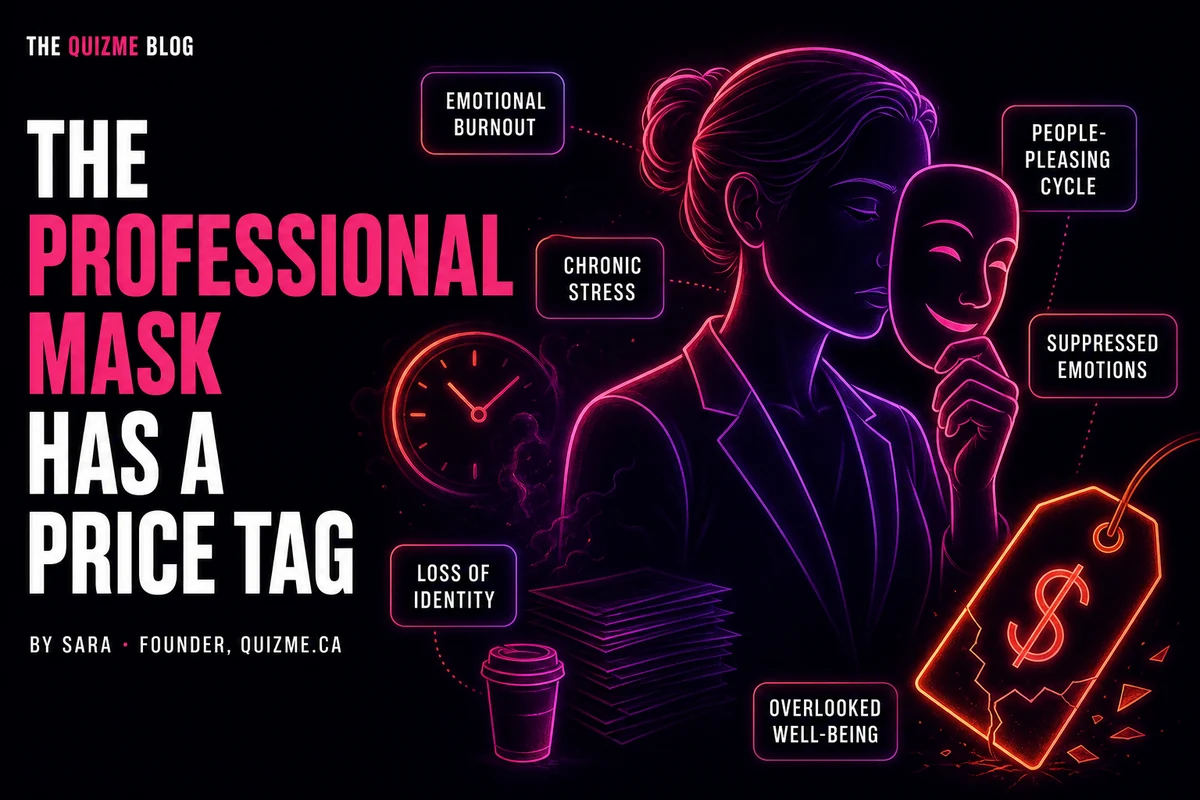
There is a version of you that shows up to work, and there is you. They share a body, a name on the org chart, and a LinkedIn headshot. Beyond that, the overlap is sometimes surprisingly thin. The professional mask, the calibrated, composed, strategic person you perform for eight-plus hours a day, is one of the most elaborate psychological constructions in modern adult life. And maintaining it is costing you more than you realize.
This isn’t about being fake, or dishonest, or even particularly anxious. It’s about something structural: the gap between your work personality and your real personality is built into how professional environments function. The question worth asking isn’t whether the gap exists. It’s how wide it is, whether you can feel it, and what it’s quietly doing to you over time.
Why the Professional Self Was Always a Construction
The word “personality” comes from the Latin persona, which literally means “mask.” Historians trace it to the masks worn in ancient theater, where different faces signaled different characters to the audience. Most personality frameworks, from the Big Five OCEAN model to the MBTI, treat that mask as the person. They assume your behavior across contexts is driven by stable underlying traits, and they’re largely right. But they rarely account for what happens when the context itself demands a very specific performance, day after day.
Workplace environments have always done exactly that. There are unwritten rules about how to sound in a meeting, how to handle your emotions when a project collapses, how to give feedback without making someone feel diminished, how excited to seem about a quarterly target you don’t care about. None of these rules are written in the employee handbook. You absorbed them by watching other people, by getting subtle signals when you got things wrong, by learning which version of yourself the environment rewarded and quietly editing the rest.
Sociologists have a phrase for the performance aspect of daily social life: impression management. The mid-20th-century theorist Erving Goffman argued that all social interaction involves a kind of stagecraft, a “front stage” performance for our audience and a “backstage” where we drop the act. Work is one of the most demanding front-stage environments most people ever inhabit, because the audience includes your income, your reputation, and your sense of professional worth.
The psychological wrinkle is that this isn’t inherently pathological. Some degree of code-switching and professional adaptation is just good social functioning. The trouble starts when the performance becomes the only mode available, when you’ve been playing the character so long you’ve started to confuse it with yourself. And that confusion has a measurable cost.
The Two Kinds of Performing (and Why One Drains You Faster)
Researchers who study what happens to workers who must manage their emotional expression at work distinguish between two broad strategies. The first is called surface acting: you feel one thing internally but display something different externally. You’re frustrated in the meeting, but you smile and nod. You’re exhausted, but you match the energy in the room. The second is deep acting: you genuinely try to shift what you’re actually feeling so that your displayed emotion is real, not performed. You talk yourself into enthusiasm. You actively reframe your irritation as curiosity.
Research consistently finds that surface acting is the more psychologically costly of the two. When the gap between what you feel and what you show is wide, and you’re holding that gap in place through conscious effort, the toll lands directly on your emotional resources. It’s the behavioral equivalent of holding your breath for eight hours. You can do it, for a while, and then one day you just can’t.
Deep acting is harder to sustain indefinitely, but it creates less internal conflict because the inside and outside are at least pointing in the same direction. The problem with deep acting over long periods, though, is different: if you get very good at generating emotions on demand, you can lose track of which emotions were yours to begin with.
One important caveat here: not everyone pays the same price for the same performance. Research on autistic adults in workplace settings, including a qualitative study centered on autistic workers’ own accounts of their experiences, found that the effort required to perform “neurotypicality” at work generates a level of cognitive and emotional exhaustion that neurotypical workers generally don’t experience in the same way. A separate perspective article on adults with ADHD made a parallel point: high-functioning performance at work can entirely conceal internal suffering, leaving the person looking fine on paper while running on something close to empty. The professional mask fits more easily on some faces than others, and that asymmetry matters.
When the Mask and the Values Don’t Match
The performed professional self becomes particularly damaging when it’s not just a stylistic adjustment but a values contradiction. Research psychologist Christina Maslach, who developed the most widely used framework for understanding occupational burnout, identified six specific areas where a mismatch between the person and the job tends to erode wellbeing over time: workload, control, reward, community, fairness, and values.1 That last one is where the work persona problem gets serious.
If your professional role requires you to consistently present views you don’t hold, advocate for priorities you don’t believe in, or perform enthusiasm about work you find meaningless, the mismatch isn’t just tiring. It accumulates as a form of moral stress. Maslach’s framework describes burnout as a three-part syndrome: emotional exhaustion, depersonalization (going through the motions, feeling detached from the people and work around you), and a reduced sense of personal efficacy.1 Values mismatch tends to accelerate all three, because the cost of pretending is highest when what you’re pretending about matters.
The connection to imposter phenomenon is worth naming here too. Psychologists Pauline Clance and Suzanne Imes, who introduced the imposter phenomenon in 1978, described it as the experience of being unable to internalize your own success, of feeling like the competent person others see is somehow a construction that will eventually be exposed. That description maps almost exactly onto what happens when you’ve built a polished professional persona: the fear isn’t just that you’ll fail, it’s that you’ll be seen without the mask. And each new professional achievement raises the stakes, because more people are now watching a version of you that you’re not sure is real.
Here, though, is where the frameworks diverge in an important way. Imposter phenomenon is about doubting your competence. The work persona problem is often the opposite: you’re competent, but the role you’re competent at performing isn’t aligned with who you actually are. These feel similar from the inside because both produce a nagging sense of inauthenticity. But the root causes are different, and that matters for what you do about it.
Feeling called out? Take the Work Personality Test That Actually Fits, it takes about 3 minutes.
Four Experiments Worth Running on Yourself
1. The Friday Afternoon Inventory
At the end of a workweek, before you shift into weekend mode, sit for five minutes with a blank page and two columns: moments this week when you felt like yourself, and moments when you felt like you were performing. Don’t over-analyze each item, just list them. After three or four weeks, look for patterns. Most people discover the same handful of situations producing the same split: certain people, certain meeting types, certain kinds of feedback. That pattern is telling you where the gap is widest. It’s also telling you where to direct your attention, because closing a small gap in a recurring context costs far less than trying to overhaul everything at once.
2. The Two-Resume Exercise
Write the resume you have: the one that uses the right action verbs, the measurable outcomes, the titles that look good in the right order. Then write a second one, the resume that would actually reflect what you care about, what kind of work made you lose track of time, which colleagues brought out something genuine in you, and what kind of problems you found yourself thinking about on weekends without being asked. The distance between those two documents is a rough map of the gap between your work persona and your actual personality. If they’re nearly identical, that’s genuinely valuable information. If they’re almost unrecognizable from each other, that’s also information you needed.
3. Notice the Code-Switch Moment
Pick a specific recurring transition: walking into a building, joining a video call, entering a particular person’s office. For one week, pay attention to what happens to you in that moment. Does your posture shift? Your vocabulary? The speed at which you speak? The opinions you volunteer? Most people who’ve built a strong professional persona can, once they look for it, identify the exact moment the performance switches on. It happens fast, often automatically. The goal isn’t to stop it from happening. It’s to notice that it’s a switch, that there was a “before” state, and that the before-state is also you.
4. Test the Tolerance of Your Environment
Pick one small, low-stakes thing that’s true about you that your professional persona typically conceals. Maybe it’s a specific interest, a genuine opinion about how something at work could be better, or simply a mood you usually hide. Introduce it once, in a context where the stakes are low. Then watch what happens. Some environments will absorb it without a ripple, which tells you the gap you’ve maintained has been partly voluntary and could be smaller. Others will respond in ways that confirm the mask is genuinely necessary there. That’s also useful to know, because it changes the question from “why am I performing?” to “is this the right stage for me?”
The Common Pitfall: Conflating Adaptation with Inauthenticity
Here’s where it’s worth pumping the brakes slightly, because the professional mask is often treated as straightforwardly bad, and that framing misses something important. Adapting your communication style to your audience is not the same as abandoning yourself. A person who scores high in agreeableness on the Big Five will naturally soften difficult feedback, someone with high conscientiousness will default to preparation and structure in ways that might feel performative to a less-conscientious colleague but are actually just how they work. The Big Five traits themselves influence how people show up professionally, and what looks like a “mask” from the outside might simply be a genuine trait activating in context.
Research on professional identity, including a study examining how strong professional identity functions as a buffer against exhaustion and disengagement, suggests that the relationship between self and role isn’t a zero-sum contest. When people feel that their professional role genuinely expresses something real about who they are, professional identity actually strengthens thriving at work rather than undermining it. The problem isn’t having a professional identity. The problem is when that identity is built entirely on performance and has no anchor in anything real.
The mask only costs you something if it fits over a face you’ve forgotten to check in with.
The nuance that often gets lost in conversations about authenticity at work is this: not every version of yourself that differs from your “off-duty” self is a lie. People contain range. You can be genuinely funnier with close friends and genuinely more precise in a professional context, and both can be real. The signal to pay attention to isn’t that your work self is different from your home self. It’s whether your work self is sustainable, whether you recognize yourself in it, and whether the effort of maintaining it is coming back to you in anything other than exhaustion.
The self-monitoring research is relevant here: high self-monitors adapt fluidly across contexts and often advance quickly in organizations because of it. But the research also finds that when the recalibration becomes so automatic that you lose track of your baseline, the psychological cost starts to mount. The skill and the cage can look identical from the outside.
What Self-Knowledge at Work Is Actually For
The real value of understanding your work persona isn’t a call to radical honesty or to start every meeting with an emotional check-in that makes your colleagues uncomfortable. It’s more practical than that. When you can see the gap clearly, you can make decisions about it intentionally rather than having it make decisions for you.
When the performance runs on autopilot long enough, you stop choosing it. It just happens. And then one day you wonder why you feel so far from yourself, when actually, you’ve been maintaining the distance deliberately for years.
The burnout literature is instructive here. Maslach and her colleagues found that burnout most reliably occurs not just from overwork, but from a mismatch between the person and the job across those six dimensions, especially when the values dimension is compromised. People who burn out from performing a professional self that contradicts their actual values tend to experience the most severe form of depersonalization: not just fatigue, but a kind of hollowness that doesn’t resolve with rest. You can sleep for a week and still feel like someone else wore your face to work.
Understanding your career identity isn’t about deciding who you “really” are in some essentialist sense. Personality research increasingly shows that who you are is partly context-dependent, and that’s not a problem to solve. The Big Five traits are relatively stable over time, but how they express in different environments varies, and that variation is normal. What self-knowledge gives you is the ability to notice when the variation has become distortion, when the professional mask has slipped from useful tool to default setting, and to ask whether the environment you’re performing for is actually one worth performing for.
The imposter phenomenon thrives in the gap between your performed competence and your ability to believe in it. But it also thrives when the competence you’re performing isn’t yours in the first place, when you’re very good at a version of work that someone else defined, in a role that was built to a template you’ve been filling ever since you figured out how to fit it. That’s a different kind of fraud feeling, and it has a different solution.
Where to Start Closing the Gap
If anything in this article made you slightly uncomfortable in a specific way, not vaguely uneasy, but specifically uncomfortable about a particular context, role, or version of yourself you’ve been maintaining, that discomfort is a starting point. It’s the kind of signal that tends to know things your more articulate, strategic thinking has been quietly overriding.
A personality framework can help you build a map, but only if the map is based on something honest. Most people who’ve taken the MBTI at work have done so in a context where they already knew what the “right” answer looked like for their role, decisive, collaborative, structured, whatever the job called for. The result is a personality profile that describes your professional mask rather than your actual personality. The work personality assessments that are actually useful are the ones that reveal the gap, not the ones that confirm the performance.
The Big Five, in particular, is worth approaching from this angle: not “how do I score?” but “where does my real score diverge most sharply from how I behave at work?” A person who scores low in extraversion but performs high extraversion all day is spending real cognitive and emotional resources on that performance. A person who scores high in openness but works in an environment that rewards rigid process is likely containing something. Neither of these is an emergency. But both are worth knowing, because they tell you where the mask is tightest, and where easing it even slightly might feel like breathing again.
The personality map you actually live in isn’t always the one on your resume or your performance review. Sometimes it’s the thing you notice on a Friday afternoon when the call ends and for a moment, before you remember to be professional again, you feel like yourself. Start there. The work of figuring out what your persona is actually costing you begins with recognizing that the person underneath it is still there, still showing up, still worth the attention.
If you’re ready to start building a clearer picture, the career section is a practical next step, especially if you’re trying to understand why a role that looks right on paper has been feeling persistently wrong.
1 Maslach, C., Leiter, M. P., &, Schaufeli, W. B. (2001). Job burnout. Annual Review of Psychology, 52, 397, 422. Maslach’s six-domain model describes the person-job fit dimensions most associated with burnout onset.