

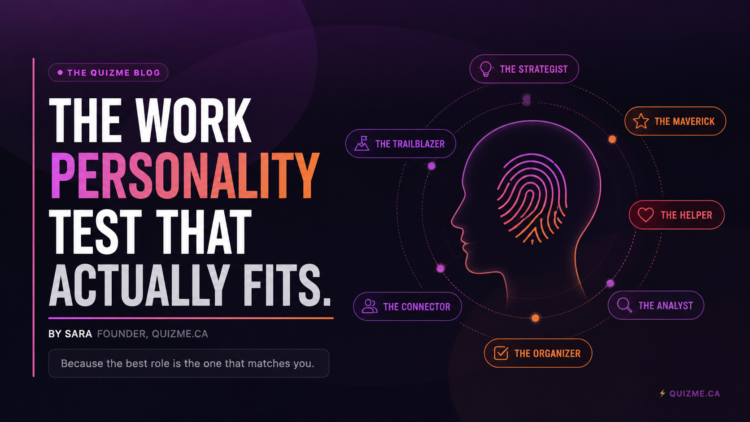
You know the drill. You’re applying for a job, or maybe just spiraling on a Sunday afternoon, and suddenly you’re forty questions deep into a work personality test trying to figure out if you’re an ENFJ or a high-Conscientiousness type or a Type 3 Enneagram achiever. And the result comes back and you think: yes, that’s me, completely. Then you retake it six months later and get something different. Sound familiar? Career personality types are everywhere right now, baked into hiring pipelines, team-building workshops, and every third LinkedIn post. But there’s a gap between how these tools are sold and what they can actually tell you, and bridging that gap is how you start using them well instead of just collecting labels.
Why the MBTI Is Everywhere at Work (and Why That’s Complicated)
The Myers-Briggs Type Indicator is the most recognizable personality framework in corporate history. Millions of people have been typed, teams have been reorganized around it, and entire coaching industries have been built on its sixteen letters. And honestly, the reason it resonates is real: when you read a profile that says you’re an intuitive, feeling type who thrives in collaborative environments, it can feel like someone finally understood you at work. That feeling matters.
But the psychometric case for MBTI is genuinely shaky. Research cited across multiple critical reviews notes that as many as 50 percent of people receive a different type classification when they retake the test just weeks later. Psychologists have pointed out that the four dichotomies MBTI uses (thinking versus feeling, judging versus perceiving, and so on) don’t reflect how these traits actually distribute in the population. Real data shows that people don’t cluster at the poles. As organizational psychologist Adam Grant has noted, “These categories all create dichotomies, but the characteristics on either end are either independent from each other, or sometimes even go hand in hand.”
There’s also the flattery problem. No MBTI profile describes you as lazy, avoidant, or difficult. Every type gets a title: “The Architect,” “The Protagonist,” “The Virtuoso.” This isn’t accidental. A test designed to make people feel good after taking it will always feel accurate, because feeling seen is itself a reward. Psychologists call this the Barnum effect: vague, affirming descriptions feel personally accurate regardless of their actual precision. The weekly synthesis note from this research puts it plainly: MBTI and similar frameworks “thrive not despite their imprecision but partly because of it: broad type labels function as identity anchors rather than diagnostic tools.”
That doesn’t mean MBTI is useless. It means you should treat it like a conversation starter about your work preferences, not a hiring credential or a ceiling on your potential.
Why the Big Five Actually Predicts Work Performance
If MBTI is the personality framework everyone knows, the Big Five model is the one researchers actually trust. Also called OCEAN (Openness, Conscientiousness, Extraversion, Agreeableness, Neuroticism), it was developed through factor-analytic methods and has been replicated across cultures in ways that MBTI simply hasn’t. The Big Five doesn’t sort you into a box. It places you on five separate spectrums, and your position on each one can shift with context, growth, and time.
For career purposes, Conscientiousness is consistently the strongest predictor of job performance across roles and industries. Research by Wright on Big Five traits in the workplace found that Organizational Skill and Efficiency are both significantly correlated with Conscientiousness (with Efficiency also negatively correlated with Neuroticism). Persistent Effort, the quality of showing up and pushing through even when work is hard, was positively correlated with both Openness and Conscientiousness, and negatively correlated with Neuroticism. Cooperation, the thing that determines whether you’re actually pleasant to work with, was positively correlated with both Extraversion and Conscientiousness.
What this means in plain language: if you consistently follow through, stay organized, and manage your anxiety at work, you are going to outperform predictions based on raw intelligence or educational background alone. And unlike your MBTI type, your Big Five profile is telling you something that changes if you work on it. Conscientiousness, specifically, responds to habit formation and environmental design. High Neuroticism, which shows up as emotional reactivity and stress sensitivity at work, is not a fixed sentence. It shifts with therapy, with better role fit, and with reduced chronic stress.
The Big Five’s weakness for career conversations is that it’s less immediately relatable. Hearing that you’re “high in Openness and moderate in Agreeableness” doesn’t feel like a revelation the way “INFP” does. But the tradeoff is validity: this framework is actually grounded in what predicts outcomes.
Feeling called out? Take the Big Five Career Fit quiz, it takes about 3 minutes.
What a Real Career Personality Framework Looks Like
Here’s the honest synthesis: no single framework gives you a complete picture of how personality shapes career fit. What the research supports is using multiple lenses, knowing what each one is actually measuring, and staying skeptical of any tool that tells you a specific job title is your destiny.
The most useful approach treats the Big Five as your foundation, because it has the strongest empirical base and actually predicts performance. From there, frameworks like MBTI or the Enneagram can add texture to your self-understanding, particularly around communication style and motivational patterns, as long as you hold them loosely. The Enneagram, for all its lack of peer-reviewed validation, does something interesting: it focuses on core fears and motivations, not just surface behaviors. That can be genuinely useful for career reflection even if it doesn’t hold up as a psychometric instrument.
Personality psychology researcher Eduard Spranger proposed six basic value attitudes that map to career orientation, and this tradition has echoed through decades of vocational psychology. The broader point holds: what matters most at work isn’t just your behavioral style but what you actually value, what kinds of problems you want to solve, and what conditions allow you to sustain energy over time. A framework that ignores values and only maps behavior is incomplete. A framework that ignores stable traits and only maps values is equally incomplete. The most useful career self-knowledge sits at the intersection.
Patterns Worth Exploring: Experiments in Career-Personality Fit
1. Run the Conscientiousness Audit
Before you invest time in typing yourself as an INFP or a Type 7, spend a week tracking one metric: follow-through rate. How often do you do what you said you’d do, when you said you’d do it, without external accountability? Conscientiousness is the Big Five trait most linked to job performance, but it’s also one of the most trainable. If your honest answer is “rarely,” that’s more actionable career data than any personality type. Design your environment to compensate: time-blocking, external deadlines, or accountability partners all function as external Conscientiousness scaffolding while you build the internal version.
2. Map Your Energy, Not Just Your Preferences
MBTI asks what you prefer. A more useful question at work is what actually costs you energy and what replenishes it. Spend two weeks keeping a brief end-of-day log. Which tasks left you feeling drained versus alive? Which kinds of interactions were depleting versus energizing? This gives you real behavioral data that personality tests can only approximate. You might discover, for example, that you test as an introvert but get genuine energy from small-group brainstorming, which changes your job-search calculus considerably. The goal is lived evidence, not self-report assumptions.
3. Test the Neuroticism Hypothesis at Work
High Neuroticism, the Big Five trait covering emotional reactivity, anxiety, and stress sensitivity, is negatively correlated with work efficiency and persistent effort. Before assuming your stress response is just “who you are,” examine it as a role-fit signal. Are you anxious in this specific job, under this specific management style, or are you anxious in most work contexts? If it’s the former, you may have a role-fit problem rather than a personality problem. If it’s the latter, this is the single highest-leverage trait to work on, because reducing chronic emotional reactivity has downstream effects on nearly every performance metric that matters.
4. Use the Enneagram for Motivation, Not Job Titles
The Enneagram lacks the empirical rigor of the Big Five, but its focus on core fears and motivations makes it genuinely useful for one specific career question: why do I keep self-sabotaging in the same way? A Type 1’s perfectionism, a Type 6’s authority anxiety, a Type 3’s fear of failure disguised as ambition: these are patterns worth knowing, not because Enneagram types are scientifically validated career predictors, but because they often name motivational traps more specifically than OCEAN dimensions do. Use it as a hypothesis generator, then verify with your own behavioral history.
5. Notice When You’re Using Type as an Excuse
Here’s the uncomfortable one. Career personality frameworks can become a way to explain away development areas rather than address them. “I’m an INFP, I’m just not built for conflict” or “I’m low in Agreeableness, that’s why I clash with everyone” are statements that sound like self-knowledge but function as avoidance. Real self-awareness includes distinguishing between stable traits you work with and habits you’ve misidentified as traits. If your personality type has been the explanation for the same problem across three different jobs, the personality type might not be the problem that needs addressing.
The Common Pitfall: Collecting Types Instead of Using Them
There is a version of career personality exploration that is actually just elaborate procrastination on the real question, which is: what do I want to do and what’s stopping me? If you have taken five different work personality tests in the last year and you’re still not sure which direction to take your career, the tests are not the bottleneck. The research on the Barnum effect is relevant here: personality descriptions that feel affirming and accurate create a sense of progress without requiring any actual change. You feel understood, you close the tab, and nothing shifts.
The antidote is using results instrumentally. When you get a Big Five profile back, the question is not “is this accurate?” but “what specific decision does this inform?” If you score high in Openness and low in Conscientiousness, the career implication is not “become a creative director.” It’s “find roles that provide structural accountability so your curiosity doesn’t collapse under the weight of deadlines.” Framework output is an input to decision-making, not a decision itself.
The same trap applies to MBTI in hiring contexts. Research consistently points out that MBTI was not designed to measure the “work self” at all, but what Myers and McCaulley called the “shoes-off self,” the private, relaxed version of a person. Using it to screen candidates or assign team roles asks a leisure instrument to do occupational work it was never built for.
What Career Self-Knowledge Is Actually For
The point of knowing your career personality type isn’t to find the job you were destined for. It’s to stop taking jobs that consistently break you in the same way.
This is the reframe that makes all of this useful. The goal of understanding your work values, your Big Five profile, your Enneagram motivational patterns, and your lived energy data is not a perfect career match. It’s pattern recognition. It’s noticing that every time you’ve taken a highly autonomous role you’ve thrived, and every time you’ve been dropped into a highly collaborative one you’ve burned out by month four. That recognition is worth more than any type label, because it’s yours, specific to your history, and it actually informs a choice.
Personality research, at its best, is about reducing the noise between who you are and what you do with your working life. The Big Five is stable across time and context, with an estimated heritability of around 50 percent, which means some of what you’re working with is genuinely fixed. But stable doesn’t mean unchangeable, and the traits most relevant to career success, particularly Conscientiousness and the management of Neuroticism, have real room to move. Knowing which parts of your personality are load-bearing and which are just habits is the most practically useful thing self-knowledge can give you.
Self-knowledge isn’t a destination. It’s a methodology for making better decisions with the person you actually are, right now.
Where to Start: Your Next Three Steps
If you want to actually use career personality typing rather than just collect it, here’s a practical starting point. First, take a proper Big Five career-focused assessment and focus specifically on your Conscientiousness and Neuroticism scores. These two dimensions have the clearest and most replicated links to job performance, and they’re the ones most worth understanding in detail. Second, run the energy audit described above for two weeks before drawing any conclusions. Real behavioral data is more reliable than any self-report instrument, including this one. Third, if you want to explore motivational patterns, use the Enneagram or MBTI as a conversation prompt rather than a conclusion, specifically by looking at where the profile describes your typical stress behavior and comparing it honestly to your actual history.
The work personality test that actually fits is not a single instrument. It’s a practice of observation, a willingness to let data from your own life update the story you’re telling about yourself, and enough intellectual honesty to notice when a label is helping you grow versus helping you stay comfortable. That practice, not any four-letter type or Enneagram number, is what career self-knowledge is actually made of.