
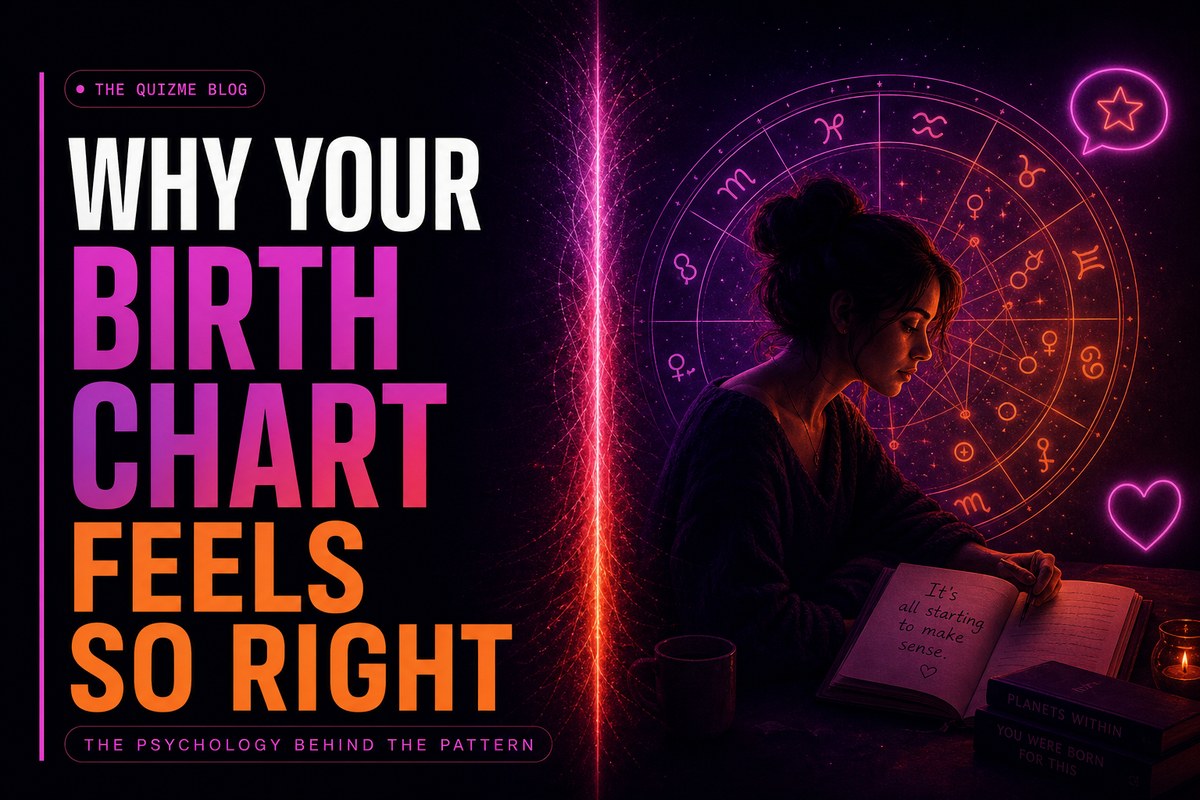
You pull up your birth chart, read the description for your rising sign, and feel a small shock of recognition. That’s me. Creative but anxious. Ambitious but self-doubting. Craving connection while fiercely guarding independence. You screenshot it. You send it to three people. You take an astrology personality quiz and feel the same warm jolt all over again. The stars, apparently, know you.
Here’s the thing nobody tells you in the astrology app: that description? It fits your best friend too. It fits your coworker who is nothing like you. It fits roughly everyone, including people born in completely different months under completely different signs. And that’s not a coincidence. It’s a feature, one that a psychologist figured out seventy years ago and that changes how the whole game works once you understand it.
Why Your Birth Chart “Nails” You (Even Though It Shouldn’t)
In 1949, psychologist Bertram Forer gave his students a personality test and promised them individualized results. A week later, each student received what appeared to be a custom profile. They rated how accurately it described them on a scale of zero to five. The average score was 4.30 out of 5. Students called it eerily accurate. Some were genuinely moved.
Then Forer revealed the twist: every single student had received the exact same vignette. Identical. Word for word. He’d assembled it directly from a newsstand astrology book.1 The profile included lines like “at times you are extroverted, affable, sociable, while at other times you are introverted, wary, reserved” and “you have a great deal of unused capacity which you have not turned to your advantage.” Universally applicable. Flattering enough to feel personal. Vague enough to mean anything.
This is called the Barnum effect, sometimes the Forer effect, and it explains a significant chunk of why your chart feels like it meets your personality in such an uncanny way. The mechanism isn’t magic. It’s the architecture of the description itself.
The Barnum Effect: How Vague Becomes Personal
Replication studies of Forer’s original finding have consistently identified two factors that drive the illusion of accuracy. First, the ratio of positive to negative statements matters enormously. Descriptions that lean flattering land harder. Second, vague language is the real engine of the effect. Phrases like “at times” allow readers to project their own specific experiences onto general statements, and the statement becomes “personal” to them in a way that feels almost magical.1
Zodiac descriptions are a masterclass in deploying both strategies simultaneously. Your Scorpio profile will call you intense and perceptive, someone who feels deeply but guards those feelings behind a composed exterior. Your Virgo profile will note your sharp analytical mind and your tendency toward self-criticism even when you succeed. Notice how both of those descriptions could apply to almost any reflective adult who has ever had a bad week? The specificity is an illusion. The flattery is the hook. The vagueness is what makes you fill in the blanks with your own story.
The effect is so reliable that Forer himself attributed it partly to gullibility, though that framing is harsher than it needs to be. What’s actually happening is something more interesting: your brain is pattern-matching and self-referencing simultaneously. You’re not being fooled. You’re doing exactly what human minds do with ambiguous information about themselves. You complete the picture.
How Astrology Compares to Validated Personality Science
Philosopher Karl Popper used astrology as his canonical example when developing the concept of falsifiability as the line between science and pseudoscience. His argument was direct: astrology “has been tested repeatedly and failed all the tests.”2 It cannot be falsified because any outcome can be reinterpreted to fit the prediction. A system that can explain everything actually explains nothing.
This is where personality psychology gets interesting by contrast. The Big Five model, openness, conscientiousness, extraversion, agreeableness, and neuroticism, was built through factor-analytic methods across independent research groups and demonstrates cross-cultural replicability. It maps onto measurable brain structures and neural networks: conscientiousness correlates with prefrontal cortex volume, neuroticism with amygdala activity, extraversion with dopamine reward system engagement (DeYoung et al., 2010, Servaas et al., 2013).3 These are not vibes. They are findings that can be challenged and, in principle, overturned.
The MBTI sits awkwardly in the middle. Between 39% and 76% of respondents receive a different type classification when they retake the indicator after only five weeks (Pittenger 1993, Grant 2013).4 The Enneagram fares worse: it carries no peer-reviewed empirical base for its nine-type system, and personality experts in one survey rated it 4.14 on a scale where 4 means “probably discredited.”5 Yet both attract devoted followings. The Barnum effect is doing heavy lifting in both cases.
If you want to go deeper on where the science actually lands, the piece on when your chart meets the science is worth reading alongside this one.
Feeling called out? Take the astrology personality quiz, it takes about 3 minutes.
The Recognition Moment: When Astrology Descriptions Backfire
Here is the version of this story that nobody posts about. You share your birth chart with a close friend, expecting them to finally understand something about you that’s been hard to articulate. They read it and nod: “Yeah, that’s so you.” And you feel briefly, warmly seen.
Then you read their chart description. And it also sounds exactly like them. Then you read a third person’s. Then you start to notice that the “hidden vulnerabilities beneath a strong exterior” line appears in almost every profile. The “loyal to a fault but slow to trust” construction shows up across six different signs. The warm recognition cools into something uncomfortable. The question underneath it: if this describes everyone, what does it actually say about me?
This is the moment astrology gets philosophically useful, not for the reason its believers think, but because the discomfort it produces is pointing at something real. The reason the description felt so accurate isn’t that the stars mapped your soul. It’s that you brought yourself to the description and found yourself there. That act, the reaching toward a framework to understand your own interior, is worth paying attention to. Why you can’t stop taking quizzes gets into the deeper psychology of that pull.
Why We Crave Zodiac Readings (The Psychology Behind It)
The honest answer is that craving a zodiac reading isn’t gullibility. It’s motivated self-knowledge, and that is a meaningful distinction. Research synthesis on the Barnum effect and popular personality frameworks suggests that people consistently prefer self-descriptions that are “affirming and coherent over ones that are accurate and complex.”6 Accuracy is almost beside the point. Coherence is what the brain is shopping for.
Identity is metabolically expensive to construct from scratch. We need anchors. Labels like “I’m a Scorpio rising” or “I’m a Type Four” function as cognitive shortcuts that organize a genuinely complicated self into something you can explain at a party. The MBTI and the Enneagram thrive on this logic too: broad type labels work as identity anchors rather than diagnostic tools, and they persist not despite their imprecision but partly because of it. Vague frameworks are easier to inhabit than precise ones.
There’s also something specific to the cultural moment. The astrology revival among millennials and Gen Z is not simply a regression to pre-scientific thinking. It’s operating in a context where institutional trust has eroded, where algorithmic recommendations feel manipulative, and where a system that centers your individual placement in the cosmos carries emotional appeal precisely because it’s personal and unchallengeable. You can argue with a Big Five score. You can’t really argue with Mercury being in retrograde.
None of this is a character flaw. The drive toward self-understanding is genuinely healthy. The question is whether the tools you’re using are giving you signal or noise. And sometimes the experience of realizing they’re giving you noise is itself the most useful signal you can get.
Patterns Worth Trying: How to Use This Knowledge
1. Notice What You Projected Into the Description
The next time a zodiac or personality description lands with that shock of recognition, pause before you screenshot it. Ask yourself: what specific memory or experience made that vague statement feel personal? The description said “at times you struggle to trust others.” What situation did your brain immediately supply as evidence? That situation, not the description, is the actual data. You just handed yourself a much more useful piece of self-knowledge than the framework provided.
2. Read Someone Else’s Description Without Knowing Their Sign
Take any zodiac profile and read it as if it were written about you, before you know which sign it belongs to. Rate how accurately it describes you. Do this with three profiles from different signs. If all three score above a 3.5 out of 5, you’ve just replicated Forer’s original 1949 finding in your own living room. That’s not cynicism. That’s empirical. It also frees you from the specific box your birth month put you in, which is genuinely liberating if you’ve ever felt trapped by a type that didn’t fit.
3. Try a Framework That Can Actually Be Wrong About You
The Big Five can be wrong about you in measurable ways. That’s a feature, not a flaw. If a framework has no mechanism for being incorrect, it has no mechanism for being useful. The work personality test that actually fits explores how trait-based models handle nuance better than type systems, and why personality quiz results are more accurate than you think gets into what “accurate” even means in this context. The discomfort of a result that doesn’t entirely flatter you is usually where the actual information lives.
4. Map the Emotional Function, Not Just the Content
Ask yourself what you were looking for when you opened the astrology app. Reassurance that your contradictions are coherent? A language for something you couldn’t explain to someone else? Permission to be a certain way? These are legitimate needs, and identifying them directly makes you a much more efficient self-knower than any chart can. Attachment styles, for instance, offer a framework for understanding relational patterns that is both emotionally resonant and grounded in research. The attachment style you didn’t know you had is a good starting place if the emotional mapping is what you’re actually after.
5. Use the Resonance as a Starting Question, Not an Answer
Here’s the move that actually works: treat any description that lands hard as a prompt rather than a conclusion. “This says I have a deep need for validation that I rarely acknowledge.” Okay. When is that true? With whom? In what situations does it disappear? Now you’re doing actual self-inquiry. The astrology or the MBTI type or the Enneagram number just handed you a door. Whether you walk through it or frame it on your wall is up to you.
The Common Pitfall and How to Get Past It
The pitfall isn’t believing in astrology. It’s mistaking the feeling of being understood for the act of understanding yourself. These are different experiences that can feel identical in the moment. A description that resonates is emotionally satisfying, but satisfaction and insight are not the same thing. You can feel deeply seen by a horoscope and still have no new information about why you keep choosing the same dynamics in relationships, or why a certain kind of work environment flattens you, or what you actually need when you’re struggling.
The way past this is not to become cynical about self-knowledge tools. It’s to ask more of them. A framework earns its place in your self-understanding when it can predict something, when it can be wrong about you in testable ways, and when it gives you language for something you couldn’t previously articulate rather than just validating what you already assumed. The Barnum effect tells us that felt accuracy is a very low bar. You deserve a higher one.
The craving for self-knowledge is one of the most human things about you. The question is whether the map you’re using is drawn from the territory of your actual life, or assembled from descriptions designed to fit everyone.
What Self-Knowledge Is Actually For
Self-knowledge tools, at their best, are not meant to tell you who you are. They’re meant to give you a working hypothesis that you can test against your behavior and update over time. The problem with systems that are too vague to be wrong is that they can’t be updated. If every outcome confirms your Scorpio nature, your Scorpio nature can’t teach you anything new.
Real self-knowledge involves the uncomfortable bits: the patterns you repeat that don’t serve you, the ways your nervous system responds before your conscious mind catches up, the gap between who you think you are and how you actually act under pressure. Why you keep dating the same person and the success that never quite feels real both get at this gap in ways that astrology readings rarely do, because they’re built around specific mechanisms rather than appealing generalities.
None of this means you have to abandon your chart. It means you might hold it differently: as one language among many, as a cultural artifact that says something interesting about what you were looking for when you picked it up, as a mirror that shows you your own projections as much as it shows you yourself. That version of astrology use is actually pretty psychologically sophisticated. Knowing that you’re doing a Barnum effect thing and choosing to do it anyway, consciously, as a ritual of self-reflection rather than a diagnostic tool, is a completely different relationship with the framework than believing it predicts something true about you.
The stars didn’t write your personality. But the fact that you’re reaching for them says something real about what you’re looking for.
Where to Start if You Want Actual Personality Insight
If the honest self-inquiry is what you’re after, the good news is that you’ve already started. Noticing that the recognition moment in a zodiac description is partly your own projection is itself a form of self-knowledge. It’s the beginning of asking better questions.
From here, a few directions are worth exploring. If you want to understand why you respond to people the way you do, the attachment research is some of the most practically useful psychology available, start with the attachment style you didn’t know you had. If you’re trying to understand your patterns in relationships specifically, why you chase and they pull away covers the dynamic in a way that’s grounded in actual behavioral patterns rather than sign compatibility. If the astrology pull is about something deeper, something about belonging or identity or finding a coherent story about yourself, your chart meets your personality does the work of putting both frameworks in conversation without pretending they’re equivalent.
And if you want to start with the quiz that prompted all of this, the astrology personality quiz is designed to surface what you’re actually looking for when you search for yourself in a birth chart. Sometimes the most useful thing a quiz can do is turn your attention back toward the question you brought to it.
1 Forer, B.R. (1949). Barnum effect replication data per Wikipedia research on the Barnum/Forer effect. 2 Popper, K., referenced in astrology and science Wikipedia research. 3 DeYoung et al. (2010); Servaas et al. (2013), cited in Big Five Simply Psychology research. 4 Pittenger (1993); Grant (2013), cited in MBTI Wikipedia research. 5 Enneagram Wikipedia research. 6 Psychology Weekly Synthesis, 2026.