
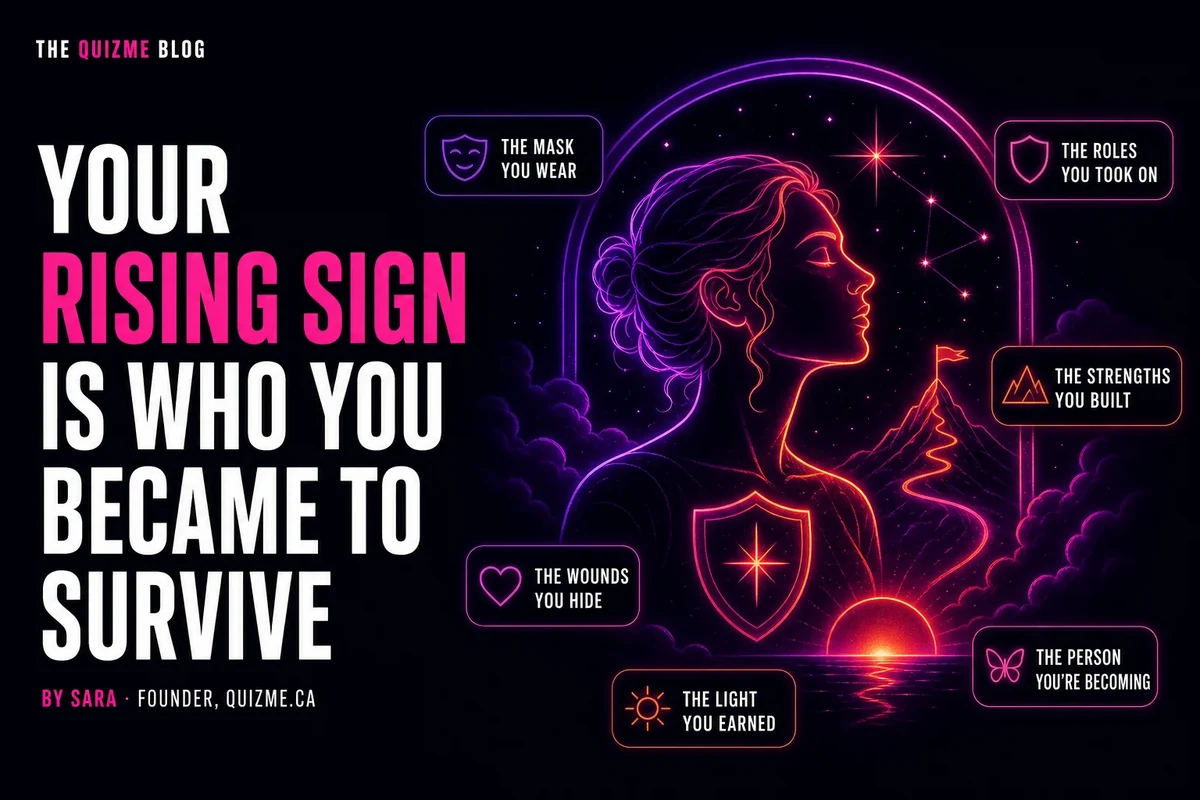
Your rising sign is supposed to be the “mask” you wear. Every astrology explainer says this, usually in the same breath, and usually without asking the follow-up question that actually matters: why did you need a mask in the first place?
The rising sign, or ascendant, is the zodiac sign that was climbing over the eastern horizon at the exact moment you were born. It changes roughly every two hours, which is why it’s the most time-sensitive point in your natal chart, and why astrologers need your birth time to calculate it accurately. In traditional astrology, it governs the impression you make on strangers, the energy you lead with, the social self that appears before anyone knows your name. You can read more about how the ascendant shapes first impressions in The Part of Your Chart Strangers See First, but this piece goes somewhere different.
The mask metaphor is useful. But it’s also incomplete in a way that makes the rising sign feel like a quirk of presentation rather than something deeper. What if the persona your rising sign describes isn’t just how you come across, but how you learned to come across? What if it’s less a costume and more a survival strategy that calcified into character?
What the Word “Persona” Actually Means
The word “personality” comes from the Latin persona, which literally meant the mask worn by actors in ancient theater. Different masks signaled different characters to the audience, not as deception, but as communication. The face through which sound passes. The character you play in the social drama. Personality psychology inherited this etymology and, with it, a built-in tension it has never fully resolved: is the mask who you are, or is it covering who you are?
Carl Jung, whose theoretical work still runs quietly under a surprising amount of modern personality frameworks, was direct about this. He conceptualized the persona as the social identity formed by the individual in response to societal demands, not as something you simply are, but as something the environment called into being. Researchers working in the Jungian tradition have since described the persona as a kind of negotiation: the self figures out what the world rewards, what it punishes, and what it simply doesn’t seem to notice, and builds a presentation accordingly. That presentation becomes the persona.1
The critical word in that last sentence is builds. The persona isn’t handed to you. It is constructed, often in childhood, often under pressure, and often so gradually that by the time you’re an adult you don’t remember assembling it. You just think that’s who you are.
This is where the rising sign gets genuinely interesting, because the claim astrology makes about the ascendant maps onto this construction quite well. The rising sign doesn’t describe your inner core (that would be the sun). It describes the face you present when the environment demands a face. And the question worth sitting with is: what environment demanded this particular face from you?
The Persona as Adaptive Strategy, Not Decoration
There’s a version of the rising sign conversation that treats it like a fashion choice: your Aries rising gives you boldness, your Libra rising gives you charm, and isn’t that delightful. That version is fine as far as it goes, but it misses something structural about how personas actually develop.
Psychology researchers studying social masking, particularly in the context of neurodivergent individuals who have written about the process in unusual detail, find that the construction of a social persona is often explicitly tied to survival in a social environment that felt unreliable or threatening. People have documented learning social body language as a deliberate, logical framework for navigation, not as intuitive exchange. The construction of social competence, these accounts make clear, does not always feel like suppression of the true self. It becomes constitutive of identity. The mask, worn long enough and skillfully enough, becomes part of the face.2
This challenges the assumption that adaptive social performance and authentic selfhood are opposites. They aren’t always. The gap between the “performed self” and the “true self” may be structurally less stable than trait psychology usually assumes, because for many people, the performed self is a true self, just one that emerged under specific conditions rather than in a neutral space. Big Five frameworks presuppose relatively stable trait expressions across contexts, what masking research reveals is that context-contingent trait expression is often a survival strategy, not a measurement error.
Apply this to the rising sign framework and the metaphor sharpens considerably. A Capricorn rising doesn’t just mean you seem serious and composed to strangers. It might mean that seriousness and composure were adaptive in an environment where chaos was the baseline, where being the responsible one kept you safe or loved or both. A Gemini rising isn’t just quick and charming. It might mean you learned early that being entertaining kept the mood light, that wit was armor, that staying in motion was safer than staying still.
The rising sign, read this way, becomes less a description of your social style and more a record of your social education.
Feeling called out? Take the astrology and psychology quiz, it takes about 3 minutes.
What the Twelve Rising Signs Might Be Protecting
Astrology gives us twelve rising signs, each with its own presentation style. Psychology gives us the insight that each style is a strategy. The combination is where things get interesting, not as a precise diagnostic map, but as a framework for asking better questions about your own social performance.
1. The Fire Risings: Aries, Leo, Sagittarius
Fire rising signs tend to lead with energy, confidence, and forward momentum. From the outside, they look self-assured, often before they’ve said a word. The psychological question worth asking is: what happens when they stop moving? Environments that taught early on that boldness was rewarded and vulnerability was punished tend to produce this kind of persona. The fire rising often learned that the best defense is a confident offense, that being the one who takes up space means no one else gets to take it from you.
The performance can be genuine and protective at the same time. Worth noting: not every fire rising is armoring against anything. Some people are simply high in extraversion and dispositional optimism, with little adaptive pressure behind the style. The suffering isn’t mandatory, and projecting it where it doesn’t live is its own kind of error.
2. The Earth Risings: Taurus, Virgo, Capricorn
Earth risings present as steady, capable, and contained. They are the ones who seem to have it together at all times, who manage situations without requiring management themselves. The psychological subtext is often an early environment where reliability was the price of security, where being the competent one kept things stable, or where emotional expression carried too much risk to be worth it.
Bowlby’s attachment research established that children who learn their emotional needs are unlikely to be met often develop highly self-sufficient social presentations, not because they feel no need, but because they learned that displaying need is unsafe.3 The earth rising presentation can look like strength and actually be a very old form of protection. It can also just be strength. Both are possible, often in the same person.
3. The Air Risings: Gemini, Libra, Aquarius
Air risings move through social spaces with ease: charming, curious, intellectually engaged, diplomatically skilled. The adaptive story here often involves environments where keeping things pleasant was essential. Families where conflict was dangerous. Classrooms where being liked was the safest currency. Social groups where fitting in required constant calibration of self.
The air rising learned to read a room, match its energy, and offer something appealing to whoever was in it. Libra rising in particular often learned that their own preferences were safest when kept secondary to the group’s. The cost shows up later: they can find it genuinely difficult to know what they want when no one is asking them to accommodate anyone else.
4. The Water Risings: Cancer, Scorpio, Pisces
Water risings present as emotionally attuned, perceptive, and often quietly intense. They pick up on what’s happening in a room before most people know something is happening at all. The adaptive logic here tends to involve early environments where emotional attunement was a form of navigation, where reading the caregiver’s mood, or the room’s temperature, was genuinely useful for staying safe or staying connected.
Scorpio rising is often read as private and controlled. The psychological story is frequently that control over information was an early source of power in an environment where being exposed felt dangerous. Pisces rising can seem boundaryless and yielding. The story is sometimes that having no distinct edges made them harder to target. These are patterns worth examining rather than accepting as fixed, which is true of any rising sign.
Where the Framework Falls Apart
Any honest treatment of this synthesis has to name where it stops working. And it stops working in several important places.
First: the rising sign is determined by the time of your birth, not the nature of your upbringing. Two people with identical Capricorn risings can have completely different developmental stories behind that presentation, one was raised in a chaotic household where stoicism was survival, the other simply has high baseline conscientiousness and low expressiveness as a temperament. The framework cannot distinguish between these. It offers a prompt for reflection, not a diagnosis.
Second: the adaptive persona story assumes that the rising sign presentation costs you something. But that’s not always true. Some people’s social presentation is genuinely continuous with their inner life, not in tension with it. A Leo rising who loves performing might not be armoring against anything. They might just love performing. Projecting a wound where there isn’t one is its own kind of distortion.
Third: the Barnum effect is real. Psychologist Bertram Forer documented in 1949 that people reliably rate vague personality descriptions as accurate when they believe those descriptions are personalized to them.4 Rising sign descriptions are often broad enough to activate this tendency across a wide range of people. “You seem composed on the outside but feel things deeply” is a statement many humans would recognize in themselves. That doesn’t mean it’s wrong about you, but it means it doesn’t automatically mean it’s right, either.
The rising sign gives you a language, not an answer. What you do with that language, whether you use it to understand yourself better or to avoid understanding yourself at all, is still entirely up to you.
The Pitfall: Wearing the Theory Instead of Using It
This is where a lot of people get stuck with both astrology and psychology frameworks: they find a description that fits and stop there. “I’m a Scorpio rising, so of course I’m private.” “I’m an Aries rising, so of course I come on strong.” The framework becomes a ceiling rather than a floor. It explains behavior instead of opening a door to examining it.
The more useful move is to treat the rising sign as a research question rather than an answer. If your ascendant describes you as emotionally guarded and self-contained, the interesting question isn’t “yes, that sounds right.” It’s: when did I learn to be this way? What was I guarding against? Is that still the environment I’m in, or am I carrying a strategy the current situation no longer requires?
Jung’s framework had a pointed observation about what happens to people who over-identify with their persona. When someone collapses entirely into their social mask, when the performance becomes the only available mode, they lose contact with the parts of themselves the mask was built to protect. The psyche doesn’t enjoy this. It tends to surface those hidden parts in inconvenient ways: in relationships where the armor suddenly drops, in moments of crisis where the composed exterior cracks, in the private self that shows up only when no one is watching. The personality traits hiding your real self are often the ones you trained yourself not to lead with.
This is also where the rising sign intersects with attachment patterns in a useful way. John Bowlby’s attachment theory established that the early relational environment, specifically, whether caregivers were reliably available and emotionally responsive, shapes not just how we form bonds but how we present ourselves in anticipation of connection or rejection.3 The rising sign and the attachment style are different maps of overlapping territory: both describe a learned strategy for navigating a social world that felt, at some point, like it required a specific kind of navigation. If you want to go deeper on those early patterns and how they show up now, the attachment style you didn’t know you had is worth reading alongside this piece.
And if the mask you built has migrated from the workplace into the rest of your life, The Professional Mask Has a Price Tag gets into what that sustained performance actually costs, in terms that go well beyond astrology. More on how personality frameworks like these map onto real psychology lives in the personality section.
What Self-Knowledge Is Actually For
There’s a version of astrology that operates like an identity vending machine. You input your birth data, you receive a set of traits, and you carry them around as a badge. That version is harmless and often fun, but it’s not particularly transformative. The same critique applies to personality typologies: an MBTI type or a Big Five profile that you use to justify your patterns rather than examine them has stopped being useful.
Bertram Malle, a social cognitive scientist at Brown University, has argued that astrology functions as a powerful vocabulary for capturing personality and life challenges, not because the planets cause anything, but because the symbolic language gives people a way to notice and articulate patterns they might not otherwise have words for. That’s a real function, worth taking seriously even if you don’t take the celestial mechanics literally.
Your rising sign is not a verdict. It is a starting point. The most interesting thing it can tell you is not “this is who you are” but “this is who you became”, and then, if you’re willing to sit with that: became in response to what? Under what conditions? And does who you became still serve who you’re trying to be?
The persona you built to survive a past environment doesn’t disappear when that environment does. It keeps showing up at the door, ready to perform. Noticing that is the beginning of choosing differently.
Where to Start
If you know your rising sign already, you have the starting vocabulary. The next move is to apply it less as a description and more as a question. Sit with what your ascendant is known for, the energy it projects, the traits it leads with, and ask when you first remember being that way. Whether it felt like you, or like something you learned. Whether there’s a version of you that exists when no one needs anything from you.
If you want to understand how your chart and your psychology interact more broadly, why your birth chart feels so right unpacks the psychological mechanisms that make astrological descriptions feel uncannily personal. For the wider territory where personality science and astrology frameworks overlap, the personality map you actually live in is a useful companion read.
Your rising sign is where people first meet you. Your attachment style is often why you let them stay. And the story between those two things, between the face you built and the person it was protecting, is the most interesting self-knowledge project most people never quite get around to.
More pieces sitting at this intersection live in the astrology section, built to be used as tools rather than labels, as questions rather than verdicts.
1 Jung, C.G. (1921/1971). Psychological Types. Princeton University Press. The application of the persona concept to socially constructed identity and its relationship to adverse life events is discussed in Jungian clinical research, including: Zeeman, E. “The psychology of discriminated ethnic minority individuals in the Netherlands: a Jungian perspective.” (peer-reviewed, summarized in research context consulted for this article.) 2 “Can Masking Be a Form of Authenticity?” ADDitude Magazine (2026). Psychology Weekly Synthesis, 2026-05-31: Masking, Identity, and the Authenticity Paradox in Neurodivergent Self-Knowledge. 3 Bowlby, J. (1969, 1973, 1980). Attachment and Loss (Vols. 1, 3). London: Hogarth Press. Ainsworth, M.D.S., Blehar, M.C., Waters, E., &, Wall, S. (1978). Patterns of Attachment. Hillsdale, NJ: Erlbaum. 4 Forer, B.R. (1949). “The fallacy of personal validation: A classroom demonstration of gullibility.” Journal of Abnormal and Social Psychology, 44(1), 118, 123. The term “Barnum effect” was coined by Meehl, P.E. (1956). “Wanted, A Good Cookbook.” American Psychologist, 11(6), 263, 272.