
You walk into a work meeting and become the focused, measured professional. You join your family for dinner and somehow revert to a slightly younger, slightly smaller version of yourself. You’re out with one group of friends and you’re sharp-edged and funny, with a different group, you’re softer, more careful with your words. None of it feels like lying. But by the end of the day, you’re exhausted in a way that’s hard to explain, and when someone asks how you’re really doing, you notice you have to think about it longer than you should. That exhaustion has a name in personality psychology, and it’s been hiding in plain sight for decades: self-monitoring.
What Self-Monitoring Actually Is (and Why You’ve Never Heard of It)
In 1974, social psychologist Mark Snyder introduced a concept that should have become as household as introversion or neuroticism, but somehow never did. He called it self-monitoring: the degree to which a person pays attention to social cues, reads a room, and adjusts their expressed personality to match what that room seems to expect. Snyder developed a Self-Monitoring Scale to measure it, and the results revealed something uncomfortable. People don’t just vary in how bold or anxious or agreeable they are. They vary in how consistently they are themselves.
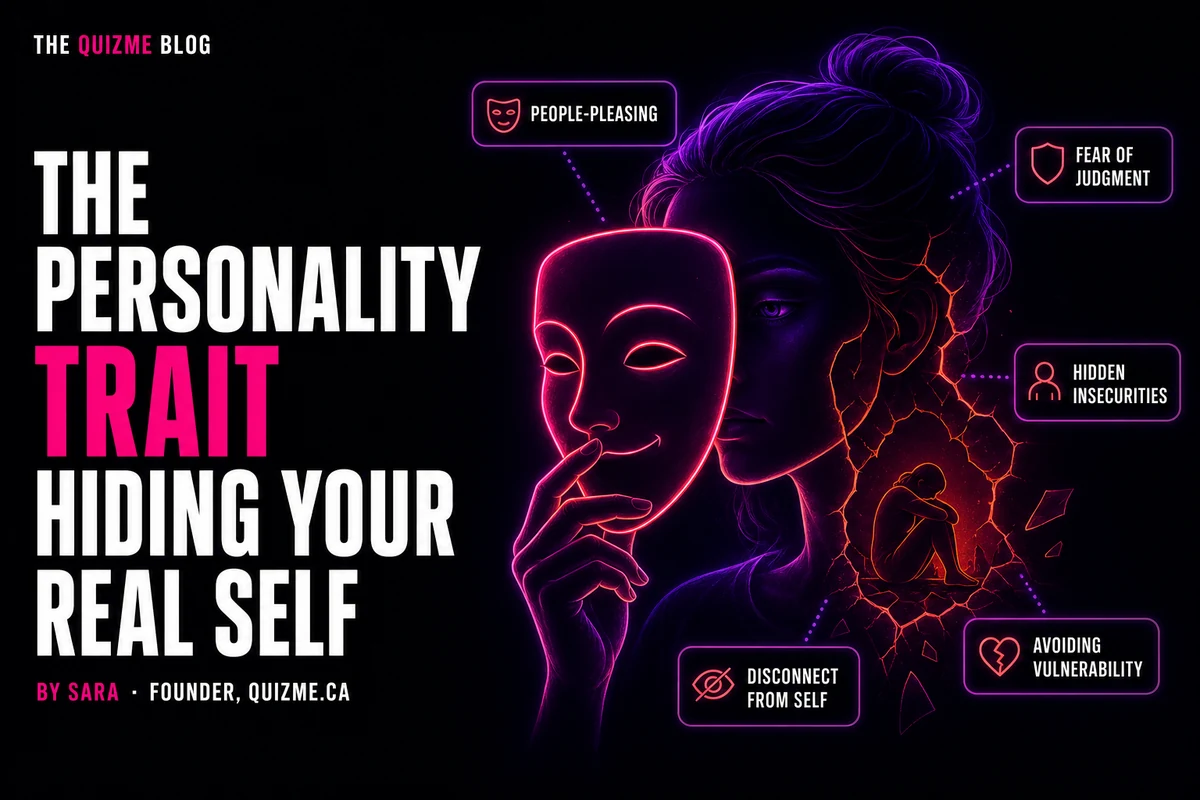
The word “personality” comes from the Latin persona, which literally means “mask.” Historians trace it to the masks worn in ancient theater, where different faces were held up to signal different characters to the audience. Most personality frameworks, from the Big Five to the MBTI, treat that mask as the face. Self-monitoring theory asks: who is wearing it, and do they even notice?
High self-monitors are the social chameleons. They’re attuned to the mood and expectations of every group they enter, and they adjust accordingly, not through deception, exactly, but through an almost automatic recalibration. They tend to be charming, versatile, and socially fluent. In career settings, they often advance faster because they’re skilled at impression management. In relationships, they can feel impossible to pin down. A high self-monitor in a relationship might feel deeply loving and present, while still projecting slightly different selves to their partner than they do to their boss, their parents, or their closest friends. That gap, over time, tends to cost something.
Low self-monitors operate from the other end of the dial. Their behavior is guided primarily by internal values, beliefs, and preferences rather than external cues. They show up roughly the same in every room, which others sometimes experience as refreshing and occasionally as tone-deaf. Low monitors tend to form fewer but deeper relationships because what you see is, genuinely, what you get. The tradeoff is social friction: reading a room less actively can mean missing signals that matter.
The Skill That Becomes a Cage
Here’s the part that doesn’t show up in most explainers on the topic: high self-monitoring is, to some degree, a skill. It correlates with social intelligence, adaptability, and leadership potential. A surgeon who reads the room well puts nervous patients at ease. A manager who adjusts their communication style to different team members is more effective than one who doesn’t. The ability to modulate your presentation is not inherently fake, and treating it like a character flaw misses the picture entirely.
The problem isn’t the skill itself. The problem is when the skill runs on autopilot, when the recalibration becomes so fast and so unconscious that you lose track of the baseline. When every performance is so well-practiced that you can no longer tell which one is the person underneath. Research on authenticity and psychological flourishing consistently finds that people who report living in alignment with their values, who feel their outward presentation reflects something real about their inner world, tend to report higher wellbeing and lower anxiety across domains. A study published in Frontiers in Psychology examined a cross-sectional sample of over 900 adults and found that authenticity served as a significant mediator between unhealthy platform use and reduced psychological flourishing, meaning that the erosion of a felt sense of genuine self-expression has measurable downstream consequences.1
The social media era has effectively turned high self-monitoring into a design feature of daily life. Every post is a performance pitched at an invisible audience. Every caption is a micro-impression-management exercise. If you already score high on self-monitoring by nature, the algorithmic feedback loop of curated self-presentation can amplify that tendency until you’re performing at all times and resting nowhere. A meta-analysis synthesizing 54 independent samples found that online upward social comparison correlates with psychological maladjustment at an average of r = 0.330, with the strongest effects seen specifically for social-evaluative negative emotions.2 You compare yourself upward, you adjust your presentation to close the gap, and the loop tightens.
Where the High/Low Monitor Split Breaks Down
Before going further, one thing has to be said plainly: the high monitor versus low monitor framing is useful, but it is not a clean binary. Snyder’s own research acknowledged that most people sit somewhere in the middle, and that situational factors matter enormously. Someone who scores as a moderate self-monitor might track social cues obsessively in high-stakes environments, like job interviews or first dates, and essentially stop monitoring entirely around their oldest friends. Context shifts the dial.
There’s also a meaningful difference between strategic self-monitoring and anxious self-monitoring. A high monitor who adjusts their presentation deliberately, from a place of social confidence and genuine interest in connection, is doing something categorically different from someone who shape-shifts because they’re terrified of being disliked. The behavior can look identical from the outside. The internal experience is completely different, and the psychological cost of the second type is considerably higher. Anxious self-monitoring looks like exhaustion, identity confusion, and a creeping sense that nobody actually knows you, including yourself.
That last feeling, by the way, is where self-monitoring intersects with the imposter phenomenon. When you’ve spent years performing competence, warmth, authority, or relatability, and the performance has worked, the thought that success is based on a curated version of you rather than the real one starts to feel uncomfortably credible. If you’ve ever felt that the version of you people admire isn’t quite the version that exists when no one’s watching, that feeling has its own psychology worth understanding.
Feeling called out? Take the personality quiz, it takes about 3 minutes.
Four Patterns Worth Sitting With
1. The Crowd-Reader Who Lost the Thread
This pattern shows up in people who are genuinely gifted socially but can no longer locate a consistent sense of self across contexts. They have a professional self, a family self, a friend-group self, a dating self, and possibly a social media self that is its own distinct entity. Each version is real in the moment. The problem is that none of them quite match, and in quiet moments, usually late at night, there’s a hollow feeling that none of them is the actual answer. If this lands, the experiment is this: spend one week noticing, without judgment, when you shift your presentation and what specifically you’re scanning for before you do it. Not stopping it, just seeing it. Awareness precedes choice. You cannot change what you cannot observe.
2. The Consistently Consistent One Who Wonders Why It’s Hard
Low self-monitors often carry a quiet frustration: they watch others navigate rooms more fluidly and wonder what they’re missing. The social ease of a high monitor can look effortless from the outside, and a low monitor might interpret their own relative inflexibility as a personal failing rather than a personality dimension with its own genuine advantages. The experiment here is the opposite of the first pattern. Instead of watching yourself adjust, spend a week noticing moments when your consistency earns you something: a conversation that goes deep unexpectedly, a relationship where someone says they feel safe with you because you’re always the same, a decision you make that reflects what you actually want rather than what the room seemed to call for.
3. The Chameleon in a Long-Term Relationship
High self-monitoring has a specific texture in intimate relationships that doesn’t get enough attention. Because high monitors are often skilled at meeting people where they are, partners can come to rely on that responsiveness without realizing they’ve never actually been challenged, disagreed with, or given a full picture of who they’re with. The high monitor, meanwhile, may experience the relationship as a prolonged performance with no backstage. The experiment: tell your partner one opinion you’ve been softening, one preference you’ve been adjusting to fit theirs, one thing you actually want that you haven’t asked for. Not a confrontation. Just a small, deliberate lowering of the dial.
4. The Social Media Self That Moved In Permanently
If you’ve ever caught yourself framing a real-life experience in terms of how it would land as a caption before it’s even finished happening, you are watching high self-monitoring fuse with digital identity construction in real time. The curated self has a gravitational pull. Once you’ve built an audience, even an audience of forty people, the feedback loop of what they respond to starts shaping what you present, and eventually what you notice and value. The experiment here is a simple one: spend 72 hours with your grid, your stories, and your takes completely offline, and pay close attention to how you feel about experiences without the implicit question of whether they’re shareable. The answer is usually illuminating and occasionally alarming.
The Common Trap: Mistaking Flexibility for Depth
The most seductive lie that high self-monitoring tells is that being likeable in every room is the same as being genuinely connected in any of them. Social fluency and intimacy are not the same skill, and they can actually work against each other. Intimacy requires revealing something that might not land well. It requires the willingness to be yourself in a room that might not particularly want that version of you. A high monitor’s relationship portfolio can look rich from the outside, with a wide network, with social warmth, with a reputation as someone everyone gets along with, while being quietly thin on the inside. Getting along with everyone is not the same as being known by anyone, and the distance between those two experiences is where a particular kind of loneliness lives.
This is also where self-monitoring intersects with attachment patterns in ways that don’t get nearly enough airtime. Anxious attachment and high self-monitoring can reinforce each other in a feedback loop: the anxiously attached person fears rejection, the high self-monitoring tendency kicks in as a protective strategy, the curated performance “works” in the sense of keeping the relationship intact, and the fear of dropping the mask hardens. The mask becomes load-bearing. Avoidant attachment can produce a different version of the same pattern, where self-monitoring is deployed not to pull people closer but to maintain the appearance of engagement while controlling how much access anyone actually gets.
The question isn’t whether you adapt to the people around you. Everyone does. The question is whether you can still find your way back to the version of you that exists when there’s nobody to adapt for.
What Genuine Self-Knowledge Is Actually For
There’s a cultural narrative about authenticity that has been well-intentioned and largely unhelpful. It presents “being yourself” as a fixed destination, as though underneath all the performance there’s a solid, stable, completely consistent self waiting to be uncovered, and the goal is to remove the masks until you find it. That framing sets up a search with no ending, because the self isn’t a thing buried under layers, it’s something constructed, ongoing, and responsive to context even in its most genuine form.
What self-knowledge through a framework like self-monitoring actually offers is something more practical: it helps you distinguish between adaptations that feel expansive and adaptations that feel like erasure. There’s a version of adjusting your communication style that makes you a better friend, partner, colleague, and human. And there’s a version that costs you access to your own preferences, reactions, and values over time. The first kind leaves you feeling more connected. The second kind leaves you feeling slightly less real.
The Big Five, the MBTI, attachment theory, even your birth chart, all of these frameworks are ultimately doing the same thing, giving you a vocabulary for patterns you’ve been living inside without language for them. Self-monitoring theory adds something specific to that vocabulary: it asks not just what kind of person you are, but how consistently you let people see it. And for many people, especially those who have spent years being professionally charming, relationally accommodating, and socially fluent, that’s the question that cuts deepest.
Personality research suggests that the most psychologically stable people aren’t the ones who never adapt. They’re the ones who know where their core is even when they’re moving around it. The dial can go up, it can go down, social context genuinely matters. But there’s a difference between choosing to read the room and being unable to stop.
Self-knowledge isn’t about stripping away every adaptation until you find some pure, original self underneath. It’s about knowing which adaptations are choices and which ones are habits you inherited from a past where they made sense.
Where to Start If This Landed for You
If the self-monitoring lens has given you something to work with, the most useful next step is probably not another abstract self-audit. It’s doing the work of understanding what your personality actually looks like under less socially charged conditions. The Big Five framework gives you one of the most empirically grounded tools available for that, precisely because it measures traits on a spectrum rather than sorting you into a type, and the full picture of how it maps to your actual life is worth exploring across everything in our personality section. It can help you see whether the version of yourself you present most often actually maps onto your underlying trait profile, or whether there’s a gap worth investigating.
If the relational dimension of this resonated, particularly the part about performing warmth while keeping people at a managed distance, the attachment style framework is the natural companion piece. And if the part about success that somehow still doesn’t feel like yours rang a bell, that specific experience has its own dedicated territory worth reading about.
You don’t have to burn the mask. You just have to know you’re holding it. The moment you can see the dial, you can start choosing where it goes. That’s not self-improvement theater, that’s actually what understanding your personality is for.
1 Social media addiction and psychological outcomes: the mediating roles of affect, authenticity, and self-image. Frontiers in Psychology, 2026. Cross-sectional sample, N = 940 participants. 2 “Looking up” linked to feeling down: a meta-analysis of online upward social comparison and psychological maladjustment. 54 independent samples, N = 36,583. Average r = 0.330 for overall maladjustment, r = 0.438 for social-evaluative negative emotions.