
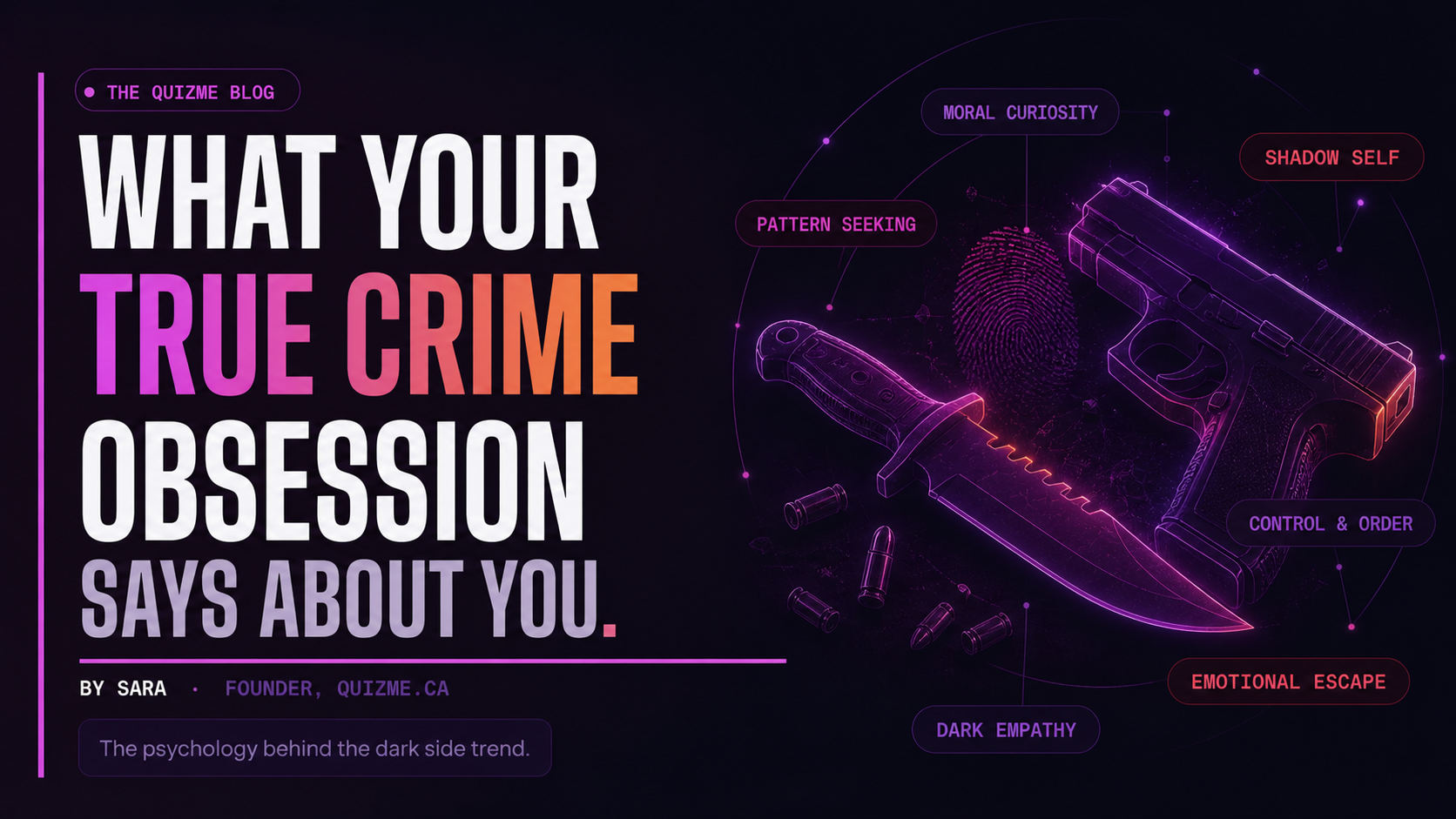
You know the drill. It’s 11 PM, you have work tomorrow, and you’re deep in episode four of a podcast about a murder that happened in 1987. You’re not scared exactly, you’re gripped. And somewhere in the back of your mind, a small voice asks: what does it say about me that I find this so compelling? The psychology of true crime fascination is genuinely interesting, and no, it does not mean you have a dark side that needs explaining away. But it does reveal something real about your personality, your nervous system, and the parts of human nature that mainstream culture usually pretends don’t exist.
Why True Crime Psychology Hits Different for Some People
Not everyone is equally drawn in. You probably know people who cannot watch a single crime documentary without nightmares, and others (maybe you) who treat it like background noise while cooking dinner. The difference is not about being desensitized or broken, it maps pretty cleanly onto personality traits that psychologists have been studying for decades.
The Big Five personality model, which is the most widely accepted framework in personality psychology today (McCrae and Costa refined it into the version we use now, built on Lewis Goldberg’s foundational work), gives us a useful starting lens. Two traits in particular do a lot of the heavy lifting here: Openness to Experience and Neuroticism. People who score high on Openness tend to be intellectually curious, drawn to complex ideas, and genuinely comfortable sitting with ambiguity. True crime is, at its core, an exercise in sustained ambiguity, motive, guilt, aftermath, the question of what anyone is truly capable of. High-Openness people find that uncomfortable territory intellectually stimulating rather than threatening.
Neuroticism, meanwhile, operates in the opposite direction. High Neuroticism correlates with anxiety and stress sensitivity, and research on the Big Five consistently finds it has a negative relationship with comfort in unpredictable or threatening contexts. If you find true crime genuinely distressing but keep watching anyway, that tension is worth paying attention to. It might be a form of controlled exposure, using fiction-adjacent narratives to rehearse emotional responses to danger from a position of safety.
This is sometimes called the “safety rehearsal” function of horror and crime media: your nervous system gets to run the threat-response sequence without any actual threat present. It is the psychological equivalent of a fire drill. Your body learns it can handle fear without catastrophe, and that, for many people, is quietly regulating rather than distressing.
Where the Dark Triad Actually Comes In (and Where It Doesn’t)
Here is where things get more interesting, and where the internet tends to catastrophize. The Dark Triad, a cluster of three personality traits comprising narcissism, Machiavellianism, and psychopathy, comes up constantly in conversations about true crime fandom, usually in a way that implies fans are secretly a little sinister. The reality is more nuanced and frankly more fascinating.
The Dark Triad framework describes subclinical traits, meaning these exist on a spectrum in the general population rather than being a diagnostic category reserved for criminals. Narcissism involves grandiosity and a need for admiration. Machiavellianism describes a strategic, manipulative orientation toward others. Psychopathy involves low empathy and high impulsivity. Research documented in the psychological literature shows that these three traits are meaningfully correlated with each other, and that individuals higher on these dimensions are more likely to engage in antisocial behavior and show reduced empathic response.
But here is what that does not mean: enjoying true crime does not indicate elevated Dark Triad scores. What the research actually suggests is that people with higher subclinical psychopathy show a specific pattern of engagement with crime content, they are more likely to identify with perpetrators, less likely to focus on victim experience, and more drawn to the “how did they get away with it” angle. Most true crime fans are the opposite: deeply oriented toward victim justice, furious at system failures, and emotionally invested in the human cost of violence. That is an empathy response, not an absence of one.
A fourth trait has also been proposed as an addition to the Dark Triad, forming what some researchers call the Dark Tetrad: sadism. The research here is interesting, studies show that only individuals exhibiting sadistic traits derived genuine pleasure from cruelty, distinguishing sadism as a construct separate from psychopathy even where they overlap. Enjoying true crime as a genre is not remotely in this territory. The distinction matters: consuming a story about violence and deriving pleasure from inflicting it are not the same psychological event.
Feeling called out? Take the Dark Triad quiz, it takes about 3 minutes.
What Your Specific True Crime Habits Actually Reveal
The genre you favor, the questions you fixate on, and what you do with the discomfort after an episode ends, these tell you more about your personality than the simple fact of being a fan. True crime is not a monolith, and neither are the people who consume it.
People who gravitate toward cases involving system failure, wrongful convictions, police misconduct, ignored victims, tend to score higher on traits associated with justice sensitivity and agreeableness in its more activist form. They are drawn to true crime as a lens on structural problems, not just individual pathology. The podcast becomes a form of civic engagement, processed emotionally.
People who are most interested in the psychology of perpetrators, the childhood patterns, the cognitive distortions, the moment something went wrong, tend to be high on Openness and often have backgrounds or genuine interest in psychology, sociology, or social work. This is intellectual curiosity pointed at one of the most extreme corners of human behavior.
And then there are the people who are primarily drawn to the detective work: the evidence, the timelines, the logical reconstruction of events. These fans often overlap with puzzle-solvers and people who score high on analytical thinking. For them, the crime is almost secondary to the epistemology, how do we know what we know, and how certain can we ever actually be?
Four Patterns Worth Examining in Your Own Obsession
1. Notice Who You Root For
Genuinely pay attention to where your emotional investment goes during a case. If you find yourself consistently focused on victim experience, family impact, and justice outcomes, your engagement is empathy-driven. If you notice yourself more fascinated by the perpetrator’s reasoning, execution, or near-misses with detection, that is not automatically concerning, it may simply reflect high Openness and a tolerance for moral complexity, but it is useful information about how your mind categorizes threat and agency. Keep a simple mental note across the next three episodes you consume. The pattern will tell you something real.
2. Track Your Nervous System Response
There is a difference between being gripped and being activated. True crime that genuinely disturbs your sleep, increases ambient anxiety, or makes you feel unsafe in ordinary environments is doing something different in your body than true crime that feels engaging and then lets you go. The Big Five research is clear that high Neuroticism correlates with difficulty recovering from threatening stimuli. If you are a person who already trends anxious, some true crime content may be functioning as a slow-drip stressor rather than the safety rehearsal it is for lower-Neuroticism consumers. The genre is not inherently harmful, but your specific nervous system’s response to it matters.
3. Ask What Question You Are Actually Trying to Answer
Most true crime fans are, underneath the genre, trying to answer one of a small number of questions: Could this happen to me? How do ordinary people become capable of this? What does the system owe victims? Could I have spotted it? These are not morbid questions, they are deeply human ones about safety, morality, and social trust. Getting specific about your actual question helps you understand what need the content is meeting and whether there are other, possibly more direct ways to meet it. Sometimes the answer is therapy. Sometimes it is a criminology course. Sometimes it really is just another episode, and that is fine.
4. Notice the Community You Build Around It
True crime fandom is unusually social. Fan forums, Reddit threads, podcast communities, and group rewatches are all part of the ecosystem. The way you engage with others around the content reveals a lot about your social personality. Are you there to share outrage? To collaboratively analyze? To feel less alone with difficult feelings about human nature? The Big Five’s Extraversion facets, sociability, warmth, the need to process emotions externally, show up clearly in how people choose to embed true crime in their social lives. Solitary late-night listening and community theorizing are both valid, and psychologically quite different activities.
The Pitfall: Using the Genre to Avoid the Feeling
Here is the part nobody puts in the podcast ads. True crime, like any absorbing media, can function as avoidance. Not avoidance of darkness, you are clearly fine sitting with darkness. Avoidance of your own life’s unresolved discomforts, routed through someone else’s crisis. The emotional engagement feels real and meaningful, because it is real. But there is a difference between processing difficult human emotions through narrative and using narrative to stay perpetually in someone else’s story so you never have to be in your own.
This is not a moral indictment of the genre. It is a question worth asking honestly, the same way you might ask it about attachment patterns that keep you busy analyzing your partner’s behavior instead of your own needs. The content is not the problem. The ratio is the question. If true crime consistently feels more emotionally available than your actual life, that is information.
The fix is not to stop watching. It is to occasionally turn the analytical lens inward with the same rigor. You are good at asking “why did this person do this?” Apply that to yourself, with the same curiosity and without the judgment.
What True Crime Fandom Is Actually About, Philosophically
The cases you find most compelling are the ones that brush up against the questions you haven’t finished answering about human nature, and your own place in it.
There is a reason true crime exploded as a genre at the exact moment that social trust in institutions was declining and people were increasingly aware of systemic failures in criminal justice. The genre fills a gap. It takes the abstract, crime, punishment, moral accountability, institutional failure, and makes it concrete, specific, and human. For a generation that grew up hearing that systems were fair and then watching that claim fall apart in real time, true crime is a way of examining the gap between what was promised and what is actually happening.
It is also, not incidentally, one of the few spaces where the experiences of victims, disproportionately women, disproportionately people of color, are treated as worthy of extended public attention. The audience for true crime is overwhelmingly people who recognize that the system has not always treated those victims as important. The fandom is, in many cases, a form of witness-bearing.
Understanding your own personality in relation to this genre is not about pathologizing a hobby. It is about noticing what kinds of stories you need, what questions you are trying to answer, and what it tells you about how you make sense of a world that includes genuine, irreducible darkness. That is not a small thing to understand about yourself.
Where to Start If You Want to Go Deeper
If this resonated and you want to actually map your own psychology rather than just theorize about it, there are a few direct routes. The Big Five personality quiz will give you a real framework for understanding your Openness, Neuroticism, and Agreeableness scores, which are the three traits most directly implicated in how you engage with dark content. If you are curious about where you actually sit on the subclinical Dark Triad spectrum, the Dark Triad test is worth taking honestly, most people score lower than they expect, which is its own kind of useful information.
For the true crime fans whose obsession is specifically about justice and system failure, the values quiz might be the most revealing: it tends to surface whether your engagement is primarily moral, intellectual, or emotional in nature. And if you noticed yourself in the section about avoidance, the attachment style quiz is a gentler entry point into understanding your own patterns than you might expect.
The cases will still be there. The podcasts are not going anywhere. But spending twenty minutes understanding your own mind with the same intensity you bring to a cold case, that is a worthwhile episode to run.